Good keyring organization is less about owning a clever accessory and more about making the right key easy to identify, carry, and return. A daily set should not feel like a pocketful of metal, while a home set should be ready when you need a spare or a rarely used key. The simplest system separates keys by job, gives each group a visual cue, and keeps storage consistent.
This guide covers work, home, and everyday carry without assuming that everyone has the same number of keys. You can apply the method to a single apartment key or a larger set that includes office access, mailbox keys, bike locks, storage units, and small tools.
Start with a key audit and three useful groups
Empty every bag, drawer, coat pocket, and bowl where keys collect. Put all keys on a table and identify each one by its function. If you cannot name a key immediately, set it aside rather than guessing. A mystery key is a sign that it needs a label, a test, or a safe place for identification.
Next, sort the keys into three working groups:
- Daily carry: keys you use most days, such as a front door, car, bike lock, or mailbox key.
- Work or routine access: office, studio, classroom, locker, or shared workspace keys that are needed on a schedule but may not belong in your pocket every day.
- Home reserve: spare keys, storage keys, guest keys, and items used only occasionally.
Do not force a key into a group just because it is small. A tiny mailbox key that you use every morning belongs in daily carry; a large key for a rarely visited storage space belongs in reserve. Frequency and consequence matter more than size.
A useful decision test is: “If I left this key at home today, would I change my route or lose access to something important?” If yes, keep it in daily carry. If not, consider a work set, reserve ring, or labeled storage hook. Review uncertain keys over a week instead of carrying everything “just in case.”
Before separating rings, check whether any keys must stay together for a lock, building policy, family member, or vehicle system. If a key is shared, avoid hiding it inside an unmarked personal set. Write a neutral label such as “back gate” or “studio cabinet,” and do not put an address, unit number, or other sensitive detail on an exposed tag.
Build a compact daily-carry set
The best daily-carry set is the smallest one that supports your normal day. Start with the essential key, then add only one item at a time. Walk through a typical morning: leaving home, entering work, collecting mail, securing a bicycle, or returning at night. If a key does not serve that routine, move it to another group.
Use a clear visual order so your hand can find the right key without searching. For example, place the front-door key nearest the clasp, the mailbox key next, and a vehicle or bike key at the end. If the keys overlap, orient them in the same direction before closing the ring. This small habit reduces fumbling at a lock.
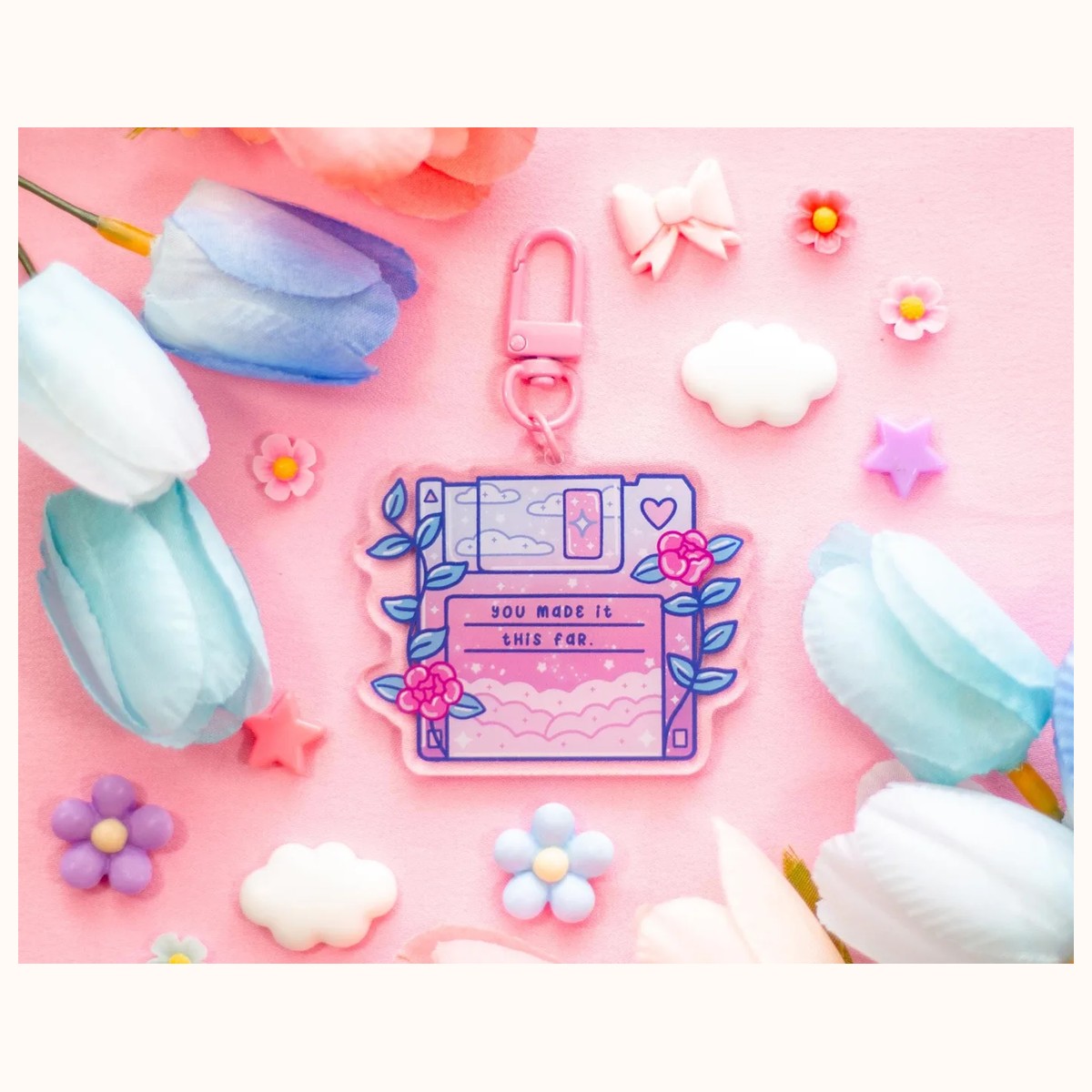
A keychain can act as a visual marker, but keep the marker proportional to the set. The Floppy Disk Aesthetic Cute Acrylic Charm Keychain is an example of a distinct charm that can help identify a group at a glance. The catalog describes it as a transparent acrylic charm with a contrasting pink clasp, double-sided printed artwork, and an approximate 2.5-by-2.5-inch size. Those details make it useful as an identifier, but the size may be more noticeable than a plain ring, so decide whether that trade-off suits your pocket or bag.
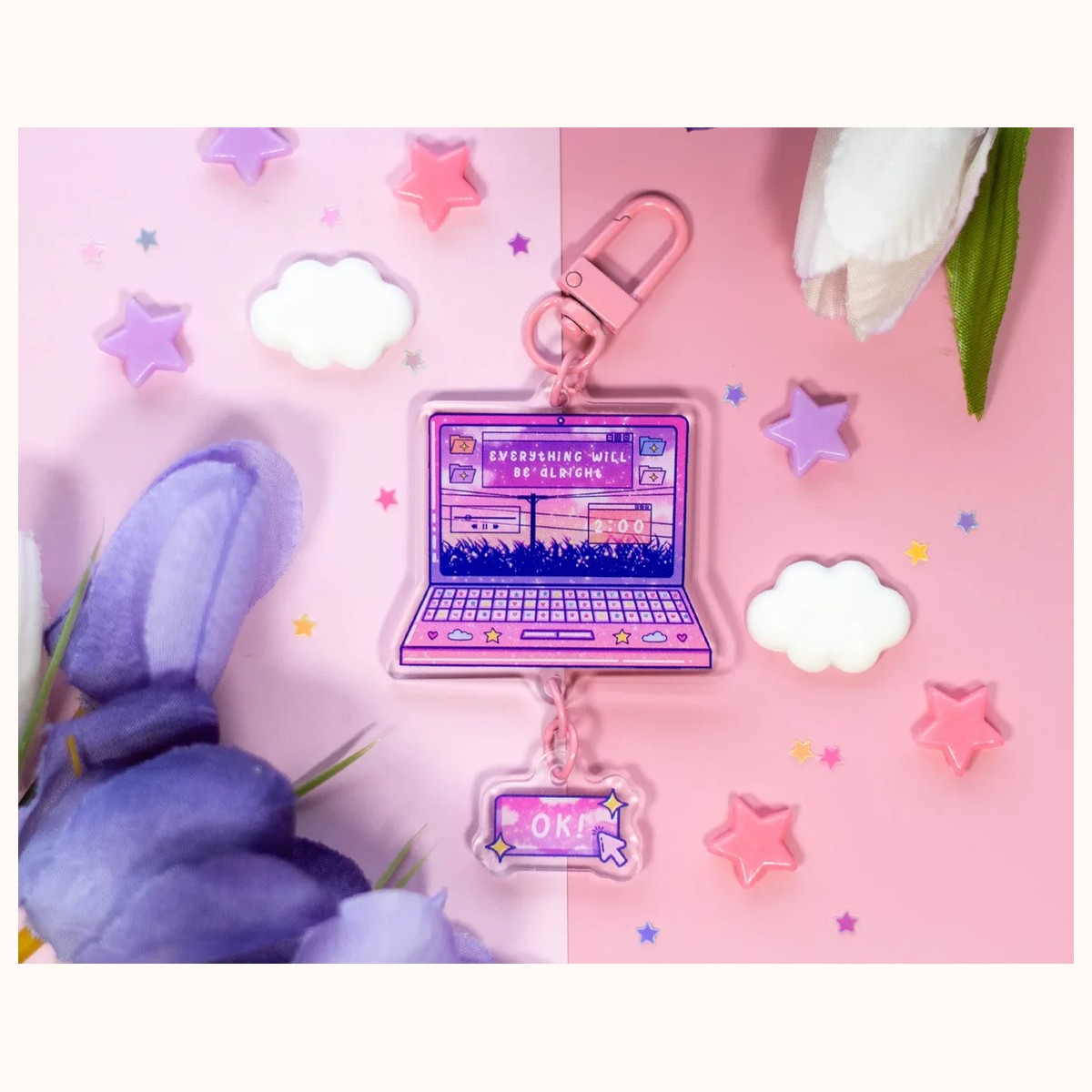
For a smaller, layered set, the Laptop Linked Keychain | Aesthetic Cute Acrylic Charm offers two connected charms. A linked design can be a good fit when you want one recognizable marker without adding separate loose accessories. It may be less suitable if dangling parts catch on a pocket, so test the movement with your usual clothing and bag before assigning it to daily carry.
If your keys scratch a phone or press into your hand, change the arrangement before buying more accessories. Move rigid or pointed keys to the outside, keep the charm facing away from delicate items, or carry the set in a small zip pocket. If the ring is difficult to open, use a separate split ring or a detachable connector for the key you remove most often. The goal is quick access, not maximum attachment.
Create work and home systems that stay separate
Work keys often create clutter because they are carried “temporarily” and then never removed. Give them a dedicated ring or connector and a dedicated storage location. A hook beside your work bag, a labeled drawer section, or a small tray can work; choose the place you will actually use when you return home.
Keep the work set visually different from the home set. A different clasp color, charm shape, or label is enough. If you prefer a bookish theme, a Stacked Books Linked Keychain | Aesthetic Cute Acrylic Charm can distinguish a work or study set from a plain home ring. The listed design uses two linked acrylic charms and a green clasp. Because linked charms occupy more space than a bare ring, reserve that arrangement for a bag handle or an outer pocket if it feels bulky in trousers.
For home reserves, use a “low traffic, high clarity” approach. Keep spare keys together only when they have the same owner or destination. Otherwise, separate them into labeled mini-groups: guest, storage, mailbox, shed, or seasonal access. Place the set in a dry, consistent location away from children and pets. The label should help you identify the key without exposing personal information if the ring is misplaced.
A reserve key should not quietly become part of daily carry. Schedule a quick monthly check: confirm that the spare is still present, the label is readable, and the lock still turns if you are able to test it safely. If a key no longer matches a lock, remove it from circulation. Keeping obsolete keys creates bulk and makes the useful ones harder to find.
For a shared household, use a simple handoff rule. The person returning a key places it on the designated hook or tray; the person taking it says where it is going if the household needs to know. A small note beside the storage spot can help during busy mornings: “Daily ring,” “Work ring,” and “Spare keys.” This is more reliable than expecting everyone to remember an informal arrangement.
Maintain the system and troubleshoot common failures
Keyring organization works when it survives real routines. Set a two-minute reset at the end of the day or whenever you return from travel. Remove receipts, temporary tags, and keys borrowed from someone else. Return each set to its assigned location before you put down your bag.
Use these troubleshooting decisions when the system starts to fail:
- The daily ring is too heavy: remove every key that was not used in the last week, then place uncertain items in a labeled temporary envelope or tray. Add back only what a real routine requires.
- You cannot tell rings apart: change one visible cue, such as the clasp, label color, or charm. Avoid labels that reveal an address or a full name.
- A charm catches on fabric: move it to a bag loop, use a shorter connector, or assign it to the home or work set instead of forcing it into a pocket.
- Keys keep separating: inspect the ring and connector for a gap or deformation. Replace damaged hardware rather than trusting a ring that opens unexpectedly.
- You keep carrying a reserve key: decide whether it is actually needed during daily travel. If it is needed only for emergencies, store it in a known reserve location and record that location in a private note.
- A shared key disappears: create one return point and add a visible, neutral label. If several people need access, consider separate copies rather than passing one ring around.
- A key is hard to identify at night: use a tactile difference, such as a distinct charm or a consistent position on the ring, instead of relying only on color.
Treat catalog descriptions as the source of product details, and check the keychains collection when comparing current options. For questions about a listing, availability, or an item’s suitability for your setup, use the store’s contact page rather than assuming a feature that is not stated.
A practical system should also be easy to revise. When you move, change jobs, add a vehicle, or stop using a lock, repeat the audit. Keep the same three-group structure, but change the contents. Over time, the result is a calmer daily carry, a work set that stays ready, and home reserves that can be found without a drawer-by-drawer search.
Related reading: 10 Best Creative Keychains for Thoughtful Gifts, How to Build a Personalized Gift Bundle, and Why Small Gifts Create Big Connections