Good keychain and bag charm styling is less about attaching everything you love and more about giving each piece enough room to be noticed. A single charm can make a tote feel personal; a small, edited group can make a backpack feel collected without becoming noisy, heavy, or difficult to use. The goal is a setup that looks intentional when your bag is hanging up and still works when you are reaching for keys, opening a zipper, or setting the bag down.
This guide uses simple decisions—function, visual weight, color, and placement—to help you build a charm arrangement that feels like yours. You can start with one acrylic keychain, add a second detail only when it earns its place, and change the arrangement as your bag or routine changes.
Start with the bag, the job, and one visual anchor
Before choosing a charm, look at the bag itself. A plain canvas tote can carry a more noticeable focal point, while a patterned backpack may need one quiet accent. Also ask what the attachment point must do. A charm on a zipper pull should be easy to grasp; a charm on a handle can be decorative but should not constantly catch against your arm; a keychain holding daily keys needs to remain easy to find and comfortable to carry.
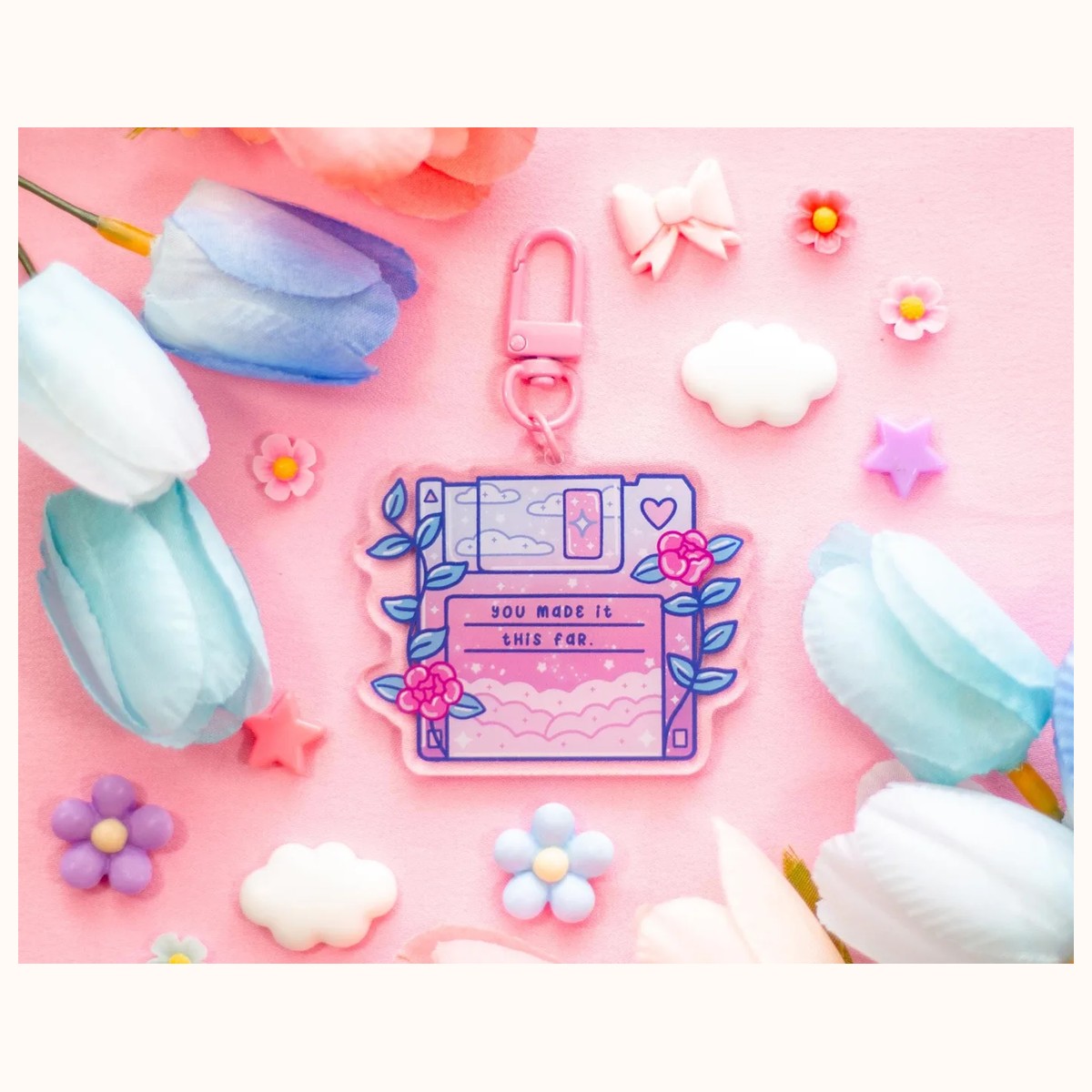
Choose one visual anchor first. This is the piece that establishes the mood or theme, such as a bookish, nostalgic, food-inspired, or technology-inspired motif. The Floppy Disk Aesthetic Cute Acrylic Charm Keychain works as a clear focal point because its square silhouette and retro subject are readable at a glance. Let it stand alone for a day before deciding whether the bag needs anything else.
A useful starting rule is one statement charm per attachment area. If your bag has two front zipper pulls, do not automatically decorate both. Put the main charm on the pull you use most, then test the bag in motion. If the charm swings into the opening, blocks the zipper tab, or makes the pull hard to grip, move it to a handle ring or choose a smaller accent.
Separate functional and decorative zones when possible. Keep a key-carrying ring for keys and use a bag loop for display, or place one charm on an outside pocket while leaving the main compartment clear. This prevents a decorative arrangement from becoming a knot of hardware every time you unlock a door.
For a restrained first setup, try this formula:
- One focal charm on the most visible or useful attachment point.
- One small supporting detail only if it adds contrast or meaning.
- Nothing attached to a zipper that you must operate quickly.
Take a photo from a few feet away. If your eye goes straight to the charm, the scale is probably doing its job. If you notice a cluster before you notice the bag, remove one piece and reassess.
Build harmony with color, scale, and silhouette
Once the anchor is chosen, use the bag’s existing colors as your guide. Matching one color is enough; a perfect color match can look overly planned. For a black, navy, or denim bag, a bright clasp or transparent acrylic can provide definition. For a pastel bag, a darker outline or a small neutral charm can stop the arrangement from blending into the fabric.
Think in a three-part palette: the bag color, the anchor color, and one accent color. For example, a lavender bag can support a purple-clasp charm plus a tiny white or silver detail. If the anchor already has several colors, keep the companion simple rather than introducing another full palette. This is especially helpful with illustrated charms, where the printed artwork is already visually active.
Scale matters more than people expect. A large charm beside a tiny charm can look layered and deliberate, but three pieces of similar large size may compete. Use a visual hierarchy:
- Large: the anchor that can be recognized from across the room.
- Medium: a companion that supports the theme without copying the outline.
- Small: a subtle tag, ribbon, or narrow accent that fills a gap rather than adding another focal point.
Silhouette is another way to avoid clutter. Pair different shapes instead of stacking identical rectangles or circles. A linked design can already provide that variation. The Laptop Linked Keychain | Aesthetic Cute Acrylic Charm has two connected transparent charms, so it creates a layered look without requiring several separate pieces. It can be a good choice when you want dimension but prefer one coordinated item.
Leave breathing room between pieces. If two charms overlap completely, one may disappear; if their edges hit one another constantly, the arrangement may look busy and make noise. Adjust the connection points so they hang at slightly different heights. A short loop keeps the anchor close to the bag, while a longer loop creates movement—use the shorter option when the bag already has a bold print or multiple pockets.
Before committing, lay the bag flat and photograph the arrangement, then carry it for ten minutes. A composition that looks balanced on a table may swing awkwardly while walking. If the charm flips backward, rotate the clasp or shift the attachment point. If the pieces tangle, reduce the number of connection points rather than adding another ring.
Choose placement for everyday movement
The best location depends on how you use the bag. A shoulder bag benefits from a charm near the outer side, where it can be seen without brushing against your clothing. A backpack often works well with one charm on a front pocket zipper, provided it does not interfere with opening the pocket. A tote can handle a handle-loop arrangement, but keep the charm away from the section that rests on your shoulder.
For keys, visibility and retrieval come first. A keychain that looks attractive but disappears inside a deep tote is not solving a problem. Attach it to a bright internal strap, a key clip, or the same pocket every time. If you use a charm on your keys, keep the ring compact and avoid adding multiple dangling objects that can catch on lining or other contents.
For zipper pulls, test the full range of motion. Open and close the compartment repeatedly, including with one hand. The charm should not prevent the zipper from reaching either end, drag across delicate fabric, or sit where it can be pinched. If it does, relocate the decoration to a fixed loop or use it on a less frequently opened pocket.
For a bookish everyday setup, a stacked-books motif can carry the theme without requiring several literary symbols. The Stacked Books Linked Keychain | Aesthetic Cute Acrylic Charm offers two linked shapes and a compact layered effect. Pair it with a plain bag and stop there, or add one very small neutral accent on a separate loop. Avoid adding another large illustrated charm; the linked silhouette is already doing the visual work.
Movement also affects durability and comfort. Keep charms clear of the floor when you set the bag down, and do not use a decorative piece as a handle for lifting a full bag. If a clasp opens during use, check that it is fully closed and move the charm to a more protected loop. If a piece becomes scratched, cloudy, or difficult to clean, treat that as a signal to reduce friction and contact with keys, metal buckles, or rough surfaces. Follow the product’s own care information rather than assuming every charm should be cleaned the same way.
Edit, rotate, and troubleshoot the finished arrangement
Clutter usually arrives gradually: one souvenir, one seasonal piece, one “temporary” ribbon, and suddenly the bag is hard to open. Set a simple limit before adding anything. Two visible pieces per side is a practical starting point, but the right number is the amount that leaves each item identifiable and the bag usable.
Use a keep, move, or store decision when editing:
- Keep a piece that is meaningful, easy to see, and not interfering with the bag.
- Move a piece that is good but poorly placed; try an inner loop, another pocket, or a different bag.
- Store a piece that duplicates the anchor, tangles, adds unwanted weight, or no longer suits your routine.
Rotation is better than accumulation. Keep a small seasonal set—perhaps a playful food motif for weekends and a quieter literary motif for work or study—then swap rather than stacking. Store unused charms in a small pouch so clasps do not scrape against one another. Photograph combinations you like; this makes it easier to recreate a balanced arrangement without experimenting in a rush.
If the bag looks busy, remove the smallest piece first. Small accents can be surprisingly distracting when several are clustered together. If it looks flat, change height or silhouette before adding color. If it feels too plain, add one detail that repeats an existing color rather than introducing a new theme. If the charm is hard to see, move it toward the outer edge or select a contrasting background instead of adding a second charm.
Finally, check the arrangement at three distances: in your hand, from a mirror, and from across a room. At hand distance, you are judging comfort and access. In the mirror, you are judging how the charm sits with your outfit and the bag’s proportions. From farther away, you are judging whether there is a clear focal point. A successful setup passes all three tests: personal up close, balanced at normal viewing distance, and practical throughout the day.
For product details, sizing, and current availability, verify the relevant keychains collection and contact Farouk Book Store through the contact page if you need clarification before choosing an attachment point.
Related reading: 10 Best Creative Keychains for Thoughtful Gifts · How to Build a Personalized Gift Bundle · 2026 Stationery Trends: Color, Texture, and Joy