You remember that you wanted to answer a letter, but you cannot remember whether you already did. The envelope is somewhere under a book, the draft is in a different notebook, and a friendly reminder has started to feel like a demand. Farouk Book Store can be a useful starting point for a small paper system that keeps your own correspondence commitments visible while leaving other people’s privacy and choices entirely out of the system.
This is not a database of friends, a scorecard for who replies, or a replacement for a weekly planning routine. It is a private memory aid for your side of a conversation: what arrived, what you want to answer, what you have sent, and what can be allowed to rest. The best version is deliberately modest. It should take less than a minute to update and should never make a relationship feel like an overdue task.
Decide what the tracker is—and is not
Start by writing a boundary at the top of the first page: “Track my replies, not people.” That sentence changes the fields you choose. You do not need a contact profile, a prediction about when someone will answer, or a running count of response speed. You need only enough context to find your own unfinished action.
A practical row can contain five short prompts:
- Received: the date or a simple month label.
- Conversation cue: a private phrase such as “recipe question” or “thank-you note,” not a copied passage.
- My next action: reply, send a photo, add an address, or decide that no response is needed.
- Status: to answer, drafted, sent, or closed.
- Review: a date when you will look once, rather than repeatedly checking.
Keep names optional. If the tracker might be seen by family, roommates, or visitors, use initials, a personal symbol, or an envelope color that means something only to you. Do not record sensitive details simply because the page has room. A paper system earns its place by reducing uncertainty, not by preserving every detail of a private exchange.
A separate “waiting” column is usually the first mistake. It encourages you to monitor someone else’s behavior. Replace it with “my next review,” and use it only for an action you control, such as checking whether you still want to send a follow-up. If the answer is no, close the row. No explanation is required.
Build a small page that survives real correspondence
Choose a format that matches how you actually write. A full notebook spread can suit someone with several letters in progress; a compact pad may work better if correspondence is occasional. Farouk’s notepads collection offers a natural place to browse formats, but select by handling and visibility rather than by trying to create an elaborate stationery set.
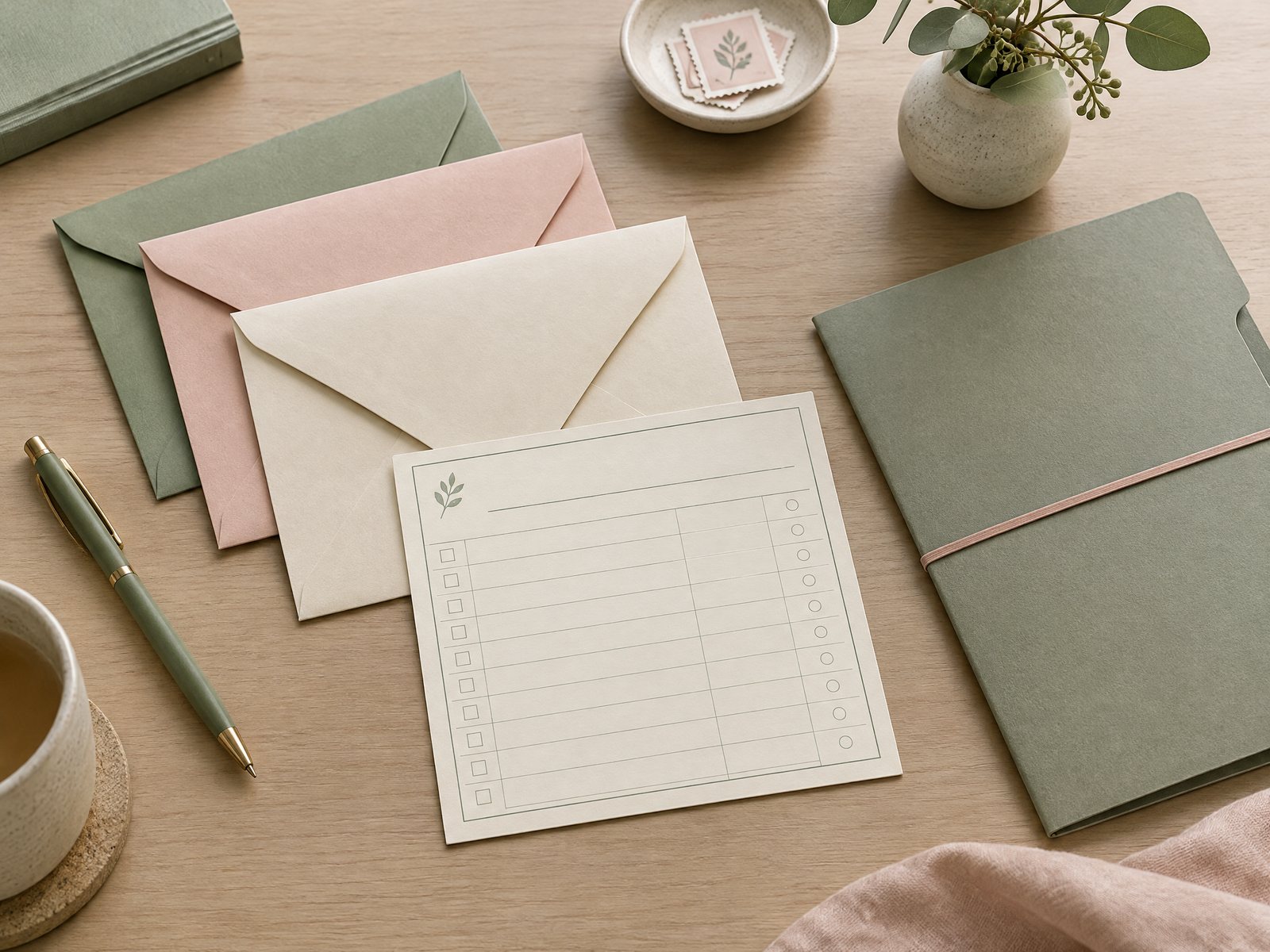
For a low-friction page, draw four narrow sections across a sheet: Cue, Next, Status, and Review. Put the received date in the cue line. Leave a little extra space under “Next,” because the action may change after you reread the envelope. A tiny checkbox beside each status is enough. Avoid a decorative layout that leaves no room for a two-sentence note.
A sticky format can help when the page needs to sit beside your writing area rather than inside a permanent notebook. The Blooming Records Sticky Notes are described in the catalog as 3 by 3 inches with 50 sheets, so they can work for a single live reply or a temporary batch. Use one note per correspondence item only if the short format is genuinely enough. If your handwriting becomes cramped, move the information to a permanent page instead of squeezing smaller letters into the same square.
For a more visible but non-adhesive setup, consider the Laundromat To Do List Planner Pad as a paper surface for a custom tracker. Its listed format is 8.5 by 5.5 inches with 50 separate sheets, and the catalog specifies that it is not sticky. That distinction matters: a loose sheet can be filed or destroyed without leaving adhesive on a desk, while a sticky note can travel with an envelope until you remove it. The product is a planner pad, not a purpose-built correspondence form, so draw only the fields you need.
If you prefer a smaller decorative cue, Dreamy Thoughts Cute Aesthetic Sticky Notes can mark a single draft or a question you want to answer. Treat the motif as a visual signal, not as a requirement to make every entry attractive. A plain pencil mark is a successful update too.
Use a calm update rhythm
The tracker works best at three deliberate moments: when something arrives, when you begin a draft, and when you send or close it. At arrival, record only the minimum cue and choose the next action. “Answer the question about the book” is more useful than copying the whole message. If you cannot answer yet, write the missing piece you control: “find the address,” “choose a photo,” or “write three lines.”
When you draft, change the status to drafted only if there is a real draft somewhere you can find. Add its location in a private shorthand, such as “blue folder” or “desk notebook.” Do not create a second obligation to polish it indefinitely. A rough but sincere reply can be ready before a perfect one.
When you send, mark the date and change the status to sent. If the message was not sent after all, move it back to to answer without treating that as failure. Sometimes a draft reveals that the timing, address, or content needs reconsideration. The tracker should make that adjustment easy.
Set one review point for open items—perhaps a quiet weekend check or the first day of the month. During review, ask three questions: Do I still want to reply? Is there a concrete thing I need to do? Would a brief acknowledgment be kinder than continued silence? The third question is about your choice, not an instruction about what the other person should do. If a reply is no longer appropriate, write “closed” and stop carrying it forward.
Keep the page out of a shared view if the information is personal. A folder, envelope, or closed notebook is enough. If a paper is lost, recreate only the open actions you remember; do not turn reconstruction into an investigation of every past exchange.
Test the system against common failure cases
Failure case: the tracker becomes another inbox. You add every message, social interaction, and possible future reply until the page is full. Adjustment: include only correspondence that needs a deliberate action from you. Casual conversations can remain where they already live.
Failure case: a reminder feels accusatory. You write “still waiting” or “why no reply?” Adjustment: replace it with a neutral self-directed phrase: “review whether I want to follow up.” If you would not want the phrase read aloud, it does not belong on the page.
Failure case: the layout encourages oversharing. A large blank box tempts you to copy personal information. Adjustment: rename it “cue” and limit yourself to a few words. Store the original letter separately, rather than reproducing it in the tracker.
Failure case: one missed update makes the whole system feel broken. You forget to mark a letter as sent and later cannot tell what happened. Adjustment: add a simple date beside the envelope or draft, then reconcile the page once. Do not backfill an entire correspondence history. The purpose is the next clear choice.
Failure case: stationery becomes a procrastination project. You keep choosing colors, headings, and accessories instead of replying. Adjustment: use one writing tool, one page, and a five-minute setup. A plain pad is more useful than a beautiful system that delays the message.
Failure case: the tracker starts measuring relationships. You add response times, rankings, or labels for who is “reliable.” Adjustment: remove those fields. Keep the record limited to your actions, your decisions, and the boundaries you want to maintain.
Keep, close, and reset with care
At the end of a small batch, review the page once. Mark sent items with dates, close items that no longer need action, and move genuinely unfinished actions to a fresh sheet. Shred or store old pages according to their privacy level. You are not required to keep a permanent archive of ordinary correspondence, and you should not assume that a longer record is a better record.
A useful reset also asks whether the format still fits. If sticky notes are disappearing, use a folder. If a large pad invites too much detail, use a smaller card. If you keep forgetting where the tracker lives, give it one home near envelopes or your writing supplies. The goal is a visible, limited reminder—not a new obligation to maintain stationery.
Farouk’s catalog is an editorial selection of paper goods and accessories, so the right choice depends on the role you want the item to play. Browse the notepads collection, compare the listed details for the products that interest you, and confirm current availability or ordering details before relying on an item. For general shop information, the About page is the appropriate place to start. A quiet paper tracker can then do its small job: help you answer when you mean to, release what you cannot control, and keep correspondence human rather than measured.
Related reading: How to Use Sticky Notes for Weekly Planning, A Brain Dump Notepad Routine for Busy Days, and How to Write a Thank-You Note That Feels Personal.