When you write a thank-you note, the goal is not to sound polished enough for a formal announcement. The goal is to help one person feel seen. A brief message can do that when it names what happened, explains why it mattered, and sounds like something you would actually say. Whether you are thanking someone for a present, a meal, practical help, an introduction, or simple kindness, specificity will make the note warmer than extra adjectives ever could.
A useful thank-you note usually needs only a few honest sentences. Start with the thank-you, add a concrete detail, describe the effect, and finish with a forward-looking line. The framework is flexible enough for a close friend, a relative, a teacher, a colleague, or someone you do not know well. The sections below show how to make each decision without turning your message into a formula.
Start with the moment you are acknowledging
Before choosing a card or writing the first line, identify exactly what you are thanking the person for. “Thank you for everything” may be sincere, but it makes the reader guess which kindness you mean. Name the occasion or action plainly: “Thank you for the cookbook,” “Thank you for staying late to help me prepare,” or “Thank you for welcoming me to dinner.”
Then ask yourself three quick questions:
- What did this person do or give?
- When did it happen, and what detail do I remember?
- What changed for me because of it?
Those answers provide the raw material for a personal note. For example, instead of writing, “Thank you for the gift,” you might write, “Thank you for the small watercolor set you brought after my move. I opened it that evening and finally felt ready to make time for painting again.” The second version gives the recipient a scene and shows that the gift had a real place in your life.
Match the opening to the relationship. A close friend might receive, “You absolutely did not have to bring me that,” while a supervisor or acquaintance may call for, “Thank you for taking the time to speak with me about the position.” Warmth does not require informality; it requires accurate attention. If the note follows a difficult event, avoid forcing cheerfulness. “Your message meant a great deal during a hard week” is often more respectful than an overly bright expression.
If you are late, do not let the delay become the whole note. A simple line such as “I have been meaning to write and did not want more time to pass without thanking you” acknowledges the gap, then moves back to appreciation. The recipient is more likely to value a sincere note today than a perfect note that never arrives.
Add one detail only you would notice
The strongest way to write a thank-you note is to include a detail that could not be copied into every message. It might be a color, a phrase someone used, a practical feature of a gift, a funny moment, or the first time you used what they gave you. One well-chosen detail is enough; listing every feature can make the note sound like a product review.
Try one of these detail prompts:
- A sensory detail: “The lemon cake was still warm when we served it.”
- A remembered phrase: “I keep thinking about your advice to begin with the smallest task.”
- A first use: “I used the travel mug on my early train this morning, and it kept my coffee beside me through the whole commute.”
- A personal association: “The constellation design reminded me of our late-night walks after astronomy club.”
- A practical result: “Your clear notes helped me walk into the meeting prepared instead of flustered.”
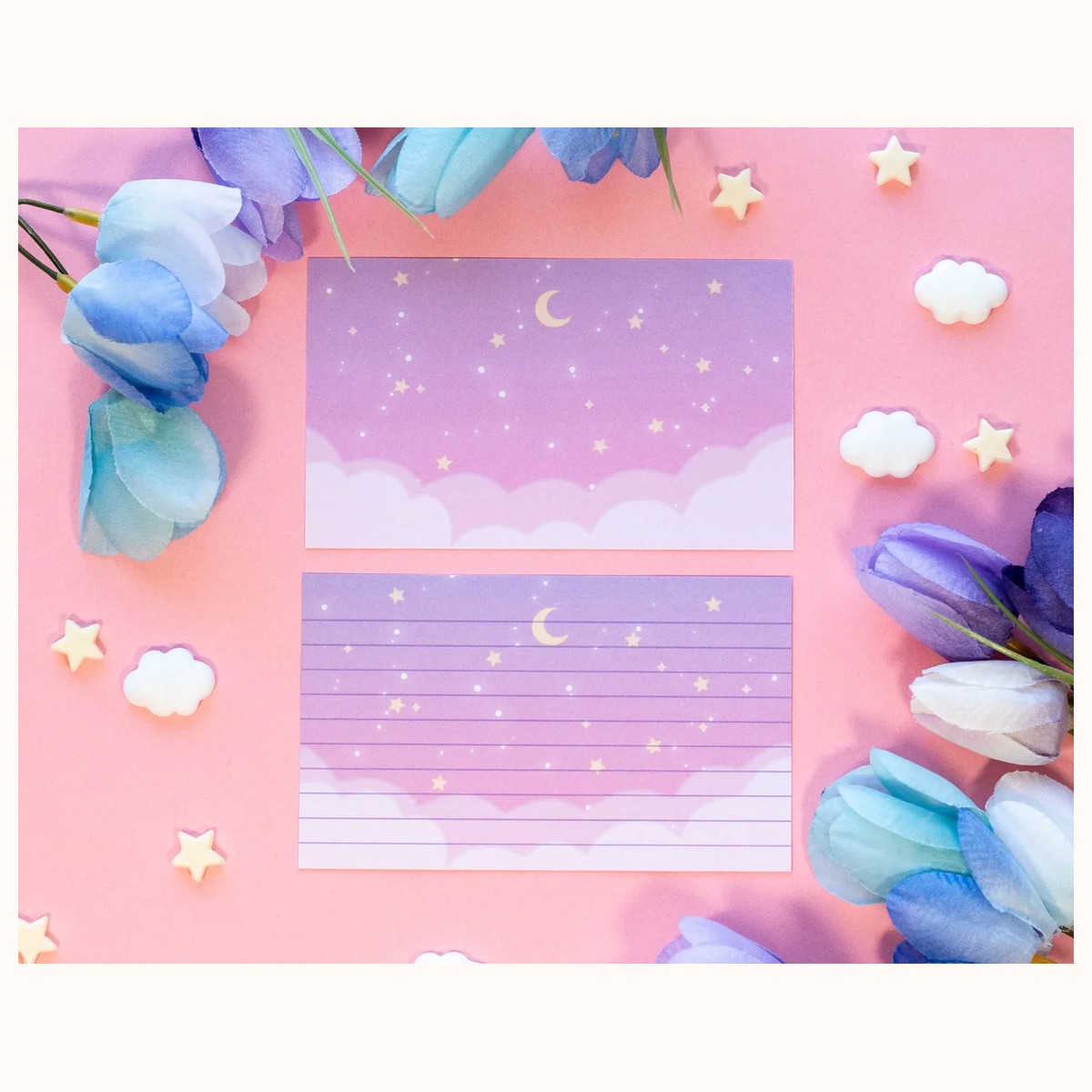
Stationery can support that sense of occasion without competing with the words. For a short appreciation message, the Starry Clouds Note Cards offer a compact 3-by-5-inch format, with one lined side for the message and one unlined side for an extra sketch or small sign-off. The product listing describes a bundle of 50 cards, so it can also suit a season of smaller notes rather than a single formal letter. Choose it because the design fits the recipient, not because decoration can replace specificity.
A detail should serve the relationship. If you are thanking a colleague for covering a shift, mention the practical relief: “I was able to take my daughter to the appointment without worrying about the closing tasks.” If you are thanking a friend for a book, name the chapter, idea, or conversation you are looking forward to. If you are thanking someone for money, say what it made possible without oversharing: “Your generous gift is going toward the art supplies I needed for the class.”
When you cannot remember a detail, be honest and use the context you do know. “It was kind of you to think of me while you were traveling” is better than inventing a story about how you used the souvenir. Never claim that a gift was perfect, useful, or already used if that is not true. You can appreciate the thought while being truthful: “Thank you for the beautiful journal; I am saving it for a project I want to begin this autumn.”
Build a message with a natural middle and close
A dependable structure is four parts: greeting, direct thanks, personal impact, and a closing that looks ahead. On a small card, each part may be one sentence. For a larger note, give the impact sentence a little more room.
Greeting: Use the name you normally use for the person. “Dear Aunt Mira,” “Hi Jordan,” and “Professor Lee” each establish a different level of closeness. If you are unsure about a title, check how the person signs emails or messages rather than guessing.
Direct thanks: Put the appreciation near the beginning. “Thank you for hosting us on Saturday” is clearer than beginning with a long update about your week.
Personal impact: Explain what the kindness meant or enabled. This is the sentence that answers the reader’s unspoken question: “Why did this matter to you?”
Forward-looking close: End with a genuine next step, good wish, or relationship cue. “I hope we can return the favor over dinner soon,” “I will send you a photo when the project is finished,” or “I look forward to seeing you at the recital” gives the note a human landing point.
Here is a complete example for a neighbor:
> Dear Sam, > > Thank you for bringing our bins in while we were away. Coming home to a clear driveway after a long trip was such a relief, and I especially appreciated the message letting us know everything was safe. We would be happy to return the favor anytime. I hope we can catch up over coffee soon. > > Warmly, > Priya
For a professional thank-you, keep the same shape but make the benefit concrete and the tone measured:
> Dear Ms. Chen, > > Thank you for reviewing my portfolio and talking through the next steps. Your suggestion to lead with the community project helped me explain my experience much more clearly. I have revised the opening and will keep you posted on the application. I appreciate your time and guidance. > > Best, > Daniel
Avoid common phrases that create distance. “Thanks for the gift, I love it” is not wrong, but it gives the recipient no evidence that you noticed their choice. “Your gift was so thoughtful” becomes more persuasive when paired with the reason: “The compact size is exactly what I needed for my crowded desk.” Also avoid adding a request immediately after your thanks unless it is genuinely part of the context; a thank-you note should not feel like an invoice or favor exchange.
If you need a more restrained visual style, browse the Note Cards collection and consider how much writing space you need. The Study Night Note Cards are described as 3-by-5-inch cards with a ruled side and blank reverse, a useful layout when you want a neat message on one side and a small illustration or longer postscript on the other. Always check the current product page for the design and details before choosing.
Edit, address, and send without losing your voice
Read the note once as the recipient. Can they tell what you appreciated? Is there a sentence that sounds like a template rather than you? Replace broad praise with one observable fact. “You are the best” might become “You remembered that I avoid dairy and brought a dessert I could actually share.” That revision is more personal because it shows attention.
Then check the practical details:
- Spell the recipient’s name correctly.
- Confirm that the gift, event, or favor is accurately identified.
- Remove jokes that could sound ambiguous outside a conversation.
- Keep private information private if the card may be seen by others.
- Make sure your closing matches the relationship.
- Sign your name clearly, especially if the recipient may not recognize your handwriting.
If your handwriting is difficult to read, slow down, use a dark pen, and leave more space between lines. Drafting in a separate notebook or on scrap paper can prevent cramped corrections. If you make a mistake on a card, do not cover it with an elaborate decoration that draws more attention. Start a fresh card when the error affects a name, address, or meaning; for a tiny harmless slip, a clean single-line correction is usually less distracting than a visibly overwritten sentence.
Choose the delivery method with the relationship and urgency in mind. A handwritten card feels especially considerate for a gift, hospitality, sympathy, or substantial personal help. A message or email may be appropriate for a quick professional follow-up or when timing matters more than ceremony. If you are thanking someone immediately after an event, send a prompt digital thank-you and follow with a card if the gesture deserves more space. Personal does not mean slow.
Finally, do not wait for ideal wording. A note that says, “I wanted you to know I noticed, and I am grateful,” can be deeply meaningful when it is true. Write in the voice the recipient knows, include one detail that proves you were paying attention, and end by keeping the connection open. That is how a small card becomes more than a polite obligation.
Related reading: Why Handwritten Greeting Cards Still Matter · How to Build a Personalized Gift Bundle · Why Small Gifts Create Big Connections