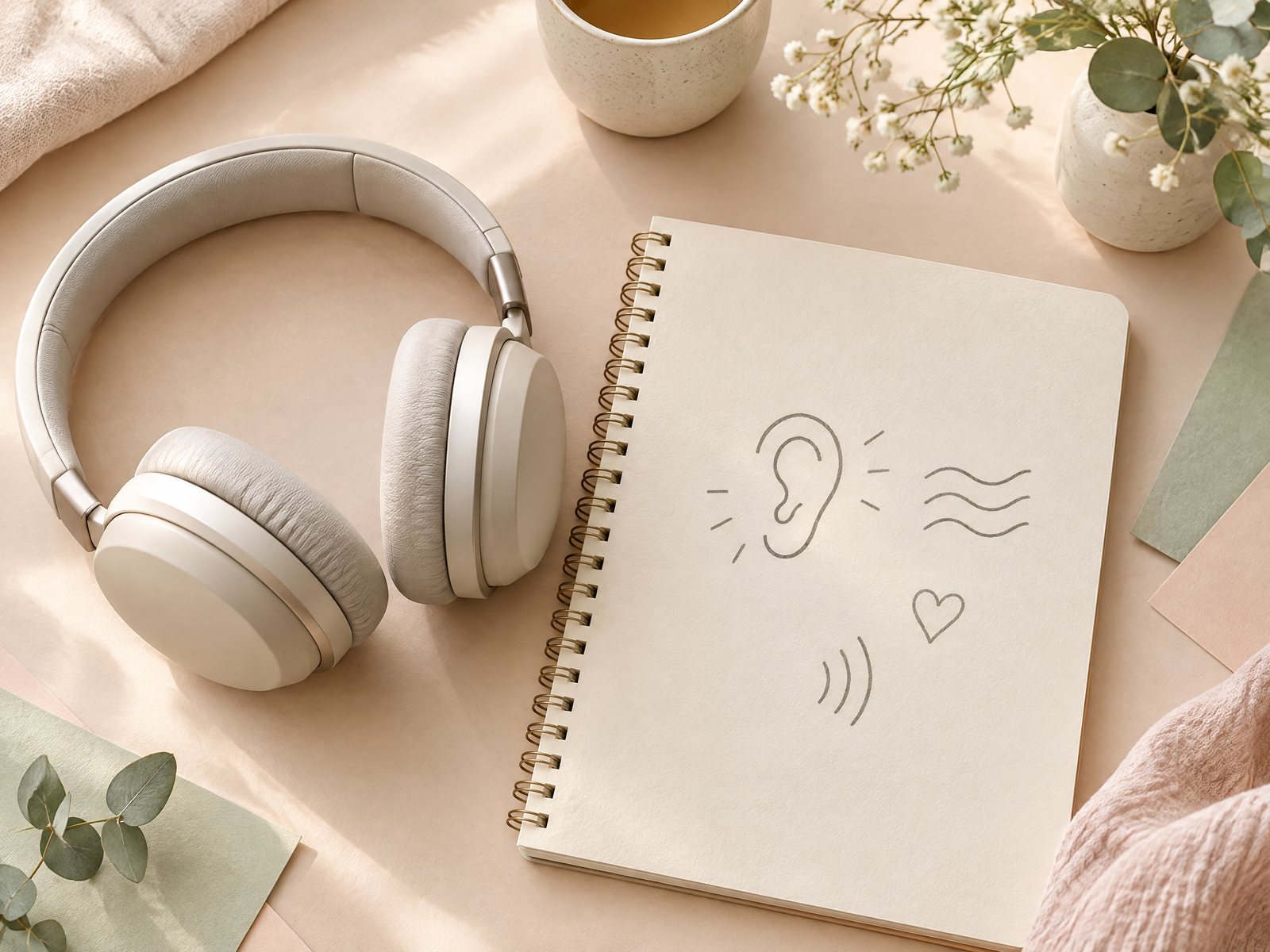
You finish an audiobook during a commute, while cooking, or on a walk, then discover that the details you wanted to keep have dissolved before you can name them. A conventional reading log can feel awkward when there are no physical pages to mark, and pausing to write a summary can pull you out of the listening experience. Farouk Book Store offers paper goods that can become a practical, personal record of what happened around your listening—not a transcript of what was said.
The useful distinction is simple: record your context and response, not the audiobook’s protected wording. Note where you listened, what changed in your thinking, or which question you want to revisit. These audiobook listening pages are deliberately lighter than a general reading journal. They give each listening session a small landing place while leaving the story itself in the authorized app or recording.
Start with the listening context, not a plot summary
Before choosing a format, decide what you actually forget. Some listeners remember a title but not where they encountered it. Others remember an emotional turn but cannot connect it to the day, narrator, or pace of listening. A useful first page can therefore contain five short fields:
- Title and creator: Identify the work in your own words, along with the author or other credited creator as shown by your listening service.
- Narrator or edition: Add the narrator, translation, abridgment, or edition only when that distinction matters to you.
- Listening setting: Record “bus to work,” “Sunday kitchen,” or another private shorthand rather than a full diary entry.
- Session marker: Write a date, a time range, or a chapter/section label supplied by the app. Do not copy passages or lengthy chapter text.
- One immediate response: Finish with a sentence such as “I kept thinking about the cost of belonging,” written from your own perspective.
This structure works because it separates reference from reflection. The first four fields help you find the experience later; the last field preserves your response. If you stop listening after ten minutes, make a tiny entry instead of forcing a complete review. “Paused during the storm; the setting felt more vivid than the characters” is enough to restart the thread.
Try a two-minute rule for the first week. At the end of a session, write one context detail and one response. If you consistently run out of space, expand later. If you regularly leave the page blank, reduce it to a single line. The page should meet the way you listen, not demand a new performance from you.
Choose paper that supports quick, uneven entries
An audiobook record benefits from a surface that tolerates fragments: a long note after an unexpected chapter, a few words after a distracted session, and occasional blank days. The Journals & Notebooks collection is a sensible place to compare formats, but the best choice depends on how you listen and carry your notes.
For a single running record, the **Botanical Bliss Spiral Lined Notebook (7x9")** is an actual Farouk catalog option with 120 lined college-ruled pages and a spiral binding that allows pages to lie flat. Its 7 x 9 inch format gives a little room for a context line, a reflection, and a follow-up question without requiring a full review. Use one page per title if you listen steadily; use a half-page per session if your listening is scattered. The floral-inspired cover is part of the catalog selection, not a claim that Farouk manufactured the design.
For a modular system, consider the Reading Room Note Cards | Kawaii Aesthetic Stationery Index Note Cards. The bundle contains 50 cards sized 3 x 5 inches, with one lined side and one blank side. Assign one card to each audiobook, or use the lined side for listening context and the reverse for a small diagram of characters, places, or ideas in your own words. Cards are particularly useful when you finish books at different rates: unfinished titles can stay in a “listening now” section without occupying a notebook’s next page.
A third option is the Pastel Academia Note Cards | Kawaii Aesthetic Stationery Index Note Cards, also listed as a 3 x 5 inch, 50-card format. Treat it as a separate queue for recommendations, questions, or books you may revisit rather than mixing every reaction into one chronological stack. Before ordering, check current product information and availability. The site bag prepares an email order request rather than a payment checkout, so inventory, taxes, and shipping still need confirmation.
Do not choose by appearance alone. Test the physical routine with scrap paper: Can you write while standing? Does the card fit beside your headphones or in your usual reading pouch? Will you recognize a title six months later? A beautiful format that stays at home may lose to a plain page that travels with the listening habit.
Build a page in three passes
A repeatable page does not need a rigid rating scale. Try three passes that match the way audiobook memories form.
Pass one: locate the session. At the top, write the title, narrator if relevant, date, and setting. Add a simple listening symbol—a headphone outline, a small dot for a short session, or a line for a longer one. Keep the symbol personal and consistent; it is an index, not decoration that must fill the margin.
Pass two: capture the response. After listening, answer one or two original prompts. “What did I notice because I heard this aloud?” can reveal rhythm, voice, or a change in attention. “What question followed me after I stopped?” preserves curiosity without retelling the book. Other useful prompts include “Which idea met my day unexpectedly?” and “What did I misunderstand at first?” These invite reflection rather than copied language.
Pass three: leave a return point. Write a next action that does not require immediate work: “look up the author later,” “ask my book group about the structure,” or “compare my reaction after the ending.” If you are still listening, note where to resume using the app’s own chapter or progress marker. Avoid reproducing a chapter heading or dialogue at length; a short personal label is enough.
For a nonfiction audiobook, add a “use with care” line: distinguish a claim you want to investigate from a conclusion you have verified. For fiction, add “image I carried away” or “relationship to watch.” For memoir, note your own boundary—what you want to think about privately and what you do not want to share. The same page architecture adapts without pretending every genre should be measured alike.
Fix the common failure cases
The page turns into a transcript. This usually happens when a sentence feels memorable and you try to preserve it word for word. Stop, close the app, and write what the sentence did to your attention instead: “The comparison made the speaker seem less reliable to me.” If exact wording matters for later reference, use the audiobook service’s legitimate bookmark or note feature rather than copying it into your paper record.
You only write after finishing. A completed title can produce a polished impression while hiding the shifts that occurred along the way. Add three tiny checkpoints: beginning, midpoint, and ending. At each one, use no more than two lines. You can revise your first reaction later, but you cannot recover a forgotten one reliably.
You record ratings and nothing else. A number makes comparison easy but says little about context. Keep a rating only if it helps your own sorting, then pair it with a specific reason: “four for the narrator’s pacing; the middle chapters lost me during a noisy commute.” The reason is the durable part.
The system becomes another task. If you skip several sessions, do not backfill every missing day. Write a reset page with the titles you remember and one honest sentence about the gap. Move the notebook or cards to the place where listening ends—near the charging cable, coat hook, or kitchen shelf. Reduce prompts until the habit feels possible again.
Other people read private reactions. Use initials, shorthand, or a separate card for sensitive thoughts. Do not record another person’s private information simply because it appeared in a memoir or conversation around your listening. Your page is for your response and context, not a second archive of someone else’s life.
Audiobook listening pages work when they preserve the shape of your attention: where you were, what you noticed, and what you may return to. Start with one notebook page or a small card stack, keep the wording yours, and let blank space remain part of the record. Farouk Book Store’s selection can supply the paper framework, while the meaning comes from the listening life you bring to it.
If you need help selecting a format or checking a current item, contact Farouk Book Store.
Related reading: Continue with How to Start a Reading Journal You Will Actually Use, Reading Journal Prompts Beyond Ratings and Summaries, and Notebook Size Guide for Journaling, Lists, and Travel.