A star rating tells you whether you liked a book, and a summary reminds you what happened. Useful as those notes are, they rarely capture the more interesting part of reading: the questions, images, disagreements, connections, and small changes in attention that remain after you close the cover. The best reading journal prompts help you record that fuller experience without turning every book into homework.
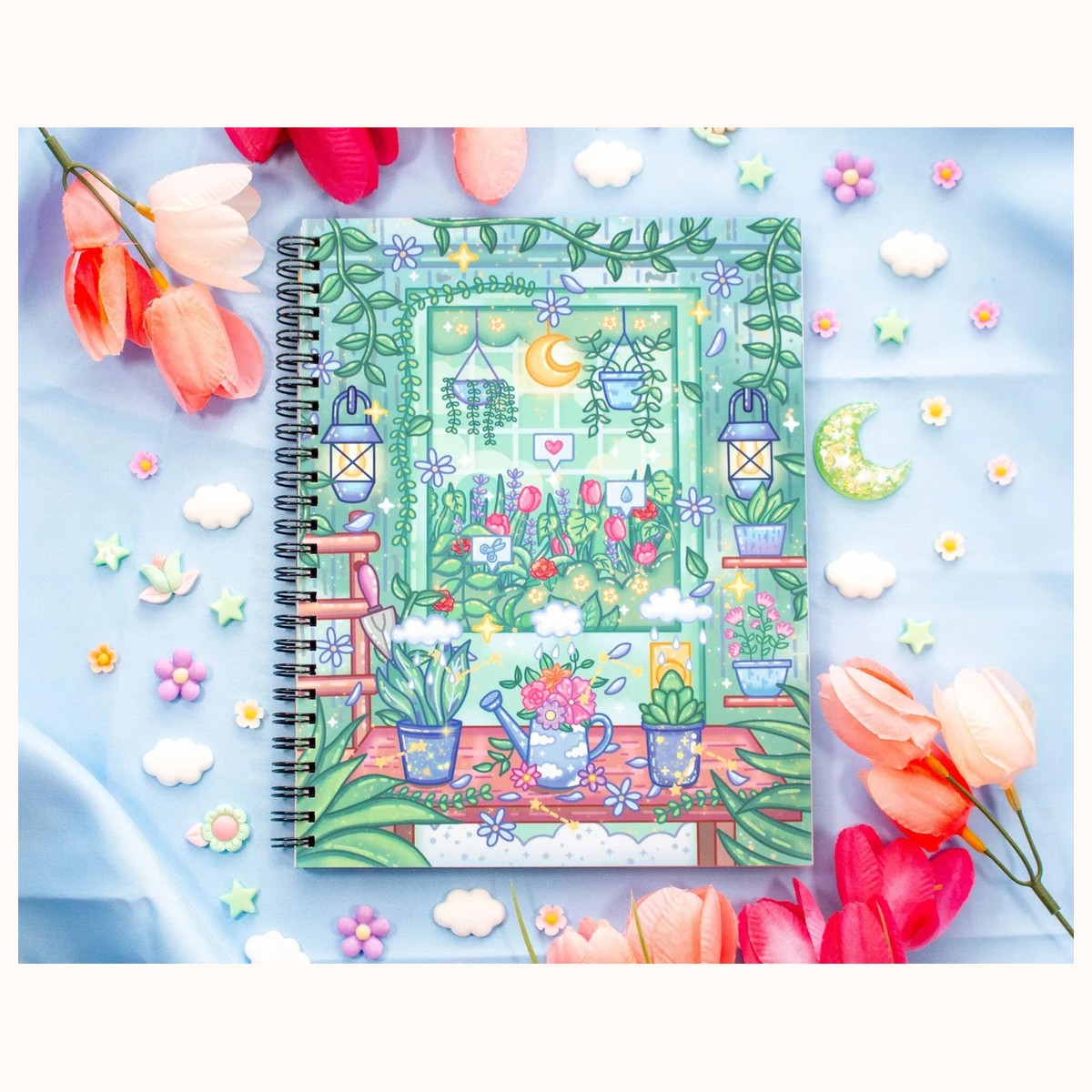
You do not need to answer every prompt. Choose one before reading, one during a pause, and one after finishing. A dedicated notebook such as the Botanical Bliss Spiral Lined Notebook gives you room for longer reflections, while a 3 x 5 note-card option in the journals and notebooks collection works well when you prefer one card per book or a portable system.
Start with your reading context, not the plot
Before judging a book, record the conditions in which you met it. Context makes later reflection more honest. A novel read during a busy week may feel different from the same novel read on a quiet holiday; neither response is automatically the “correct” one.
Try these opening prompts:
- Why did I choose this book now?
- What did I expect from the title, cover, recommendation, or author?
- What do I already know about the subject, setting, genre, or period?
- What kind of attention can I realistically give this book today?
- What mood, worry, hope, or recent experience am I bringing to the first page?
- What would make this reading experience worthwhile, even if I do not love the book?
Write the date, location, format, and starting page if those details help you. You might note, “Reading on the train; expecting a fast mystery; low energy,” rather than forcing yourself to invent a polished opinion. That sentence becomes useful evidence when you revisit your final response.
A context note also helps with a common problem: confusing difficulty with poor quality. If you are distracted, unfamiliar with the vocabulary, or reading in short bursts, mark that down. Then decide whether to continue, slow down, use a companion resource, or pause the book. The journal is not a courtroom; it is a record that helps you make a better reading decision.
A quick pre-reading choice
Pick one intention instead of setting an ambitious reading goal. You might read to notice how the narrator creates trust, to learn the basics of a historical moment, to study an author’s use of dialogue, or simply to spend twenty calm minutes away from a screen. At the end, ask whether the intention still fits. If not, revise it rather than treating the change as failure.
Capture reactions while they are still specific
A summary usually follows the order of events. A reflective journal can follow your attention instead. When a passage makes you laugh, tense up, reread, or look away, record the moment and your response before it becomes a vague “good part.” Avoid copying long passages; a page number and a short phrase are usually enough for you to find the scene again.
Use prompts such as:
- What exactly made me pause here?
- Which detail can I picture, hear, or feel most clearly?
- What did I assume would happen, and how did the book confirm or challenge it?
- Which character, speaker, or idea am I resisting? Why?
- What emotion is present on the page, and what emotion is the scene creating in me?
- Where did my attention drift, and what might that tell me about the pacing or my circumstances?
- What question am I carrying into the next chapter?
For a practical system, divide a page into three small areas: “notice,” “feel,” and “wonder.” Under “notice,” write a concrete image, line of dialogue, structural move, or recurring object. Under “feel,” name your response without grading it: uneasy, amused, impatient, protective, unconvinced. Under “wonder,” write the question that remains open. This takes less time than a full paragraph and gives you material for a richer final entry.
If you use tabs or removable notes, keep the mark simple: a question mark for uncertainty, an exclamation mark for surprise, and a small eye symbol for a detail you want to watch. The Starry Clouds Cute Aesthetic Bookmark can mark your current place without adding a complicated annotation system. If you dislike writing in books, place page references on a separate card and transfer only the most useful observations later.
When notes become too much
If you stop enjoying the book because you are documenting every page, reduce the frequency. Set a rule such as one note per chapter, one note per reading session, or one note whenever your response changes. A journal should support attention, not compete with it. If you cannot remember what to write, use the simplest prompt: “What stayed with me after I put the book down?”
Look at how the book works
Once you have recorded your reactions, examine the choices that produced them. This moves your journal beyond “I liked it” without requiring a formal literary essay. Focus on one craft feature at a time and connect it to a specific effect.
Prompts for fiction and narrative nonfiction
- How does the opening establish a promise, problem, or atmosphere?
- What does the narrator reveal, delay, misunderstand, or leave unsaid?
- How do setting and objects influence the choices people make?
- Where does the pace accelerate, slow down, or repeat—and what effect does that create?
- Which relationships change, and what causes the change?
- What pattern appears in images, phrases, seasons, food, clothing, rooms, or journeys?
- Does the ending resolve the central tension, reframe it, or intentionally leave it open?
Prompts for nonfiction, essays, and practical books
- What is the author’s central claim in my own words?
- Which example makes the argument clearer, and which feels less convincing?
- What evidence, experience, or assumption is carrying the most weight?
- What important perspective is missing or underexplored?
- Which idea could I test in a small, low-risk way this week?
- What would change my mind about the author’s conclusion?
Always separate observation from interpretation. “The narrator switches to shorter sentences” is an observation; “the character is panicking” is an interpretation. Writing both, and labeling them mentally or on the page, makes your notes more precise. If you disagree with an interpretation, keep the disagreement specific: identify the scene, explain your reading, and name what evidence might support another view.
For a book with dense concepts, use one page for “claims” and another for “applications.” On the claims page, summarize the author’s position fairly. On the applications page, note where the idea fits your life, work, studies, or other books—and where it does not. This prevents a memorable phrase from becoming an untested rule.
Turn reflection into a reusable practice
The final entry should help future-you, not merely finish the assignment. Instead of asking only “What is this book about?”, ask what you want to remember, recommend, question, or do next.
Choose several closing prompts:
- What is one image, idea, or sentence I want to carry forward?
- What did this book help me notice about my own assumptions?
- Which earlier note changed meaning by the end?
- What would I tell a friend who is considering this book?
- Who might connect with it, and who might reasonably avoid it right now?
- What companion reading, conversation, or real-world observation would deepen this experience?
- Would I reread it? If yes, what would I watch for next time?
- What is my current recommendation, and what caveat belongs beside it?
You can still include a rating, but make it one data point rather than the conclusion. Try a two-part verdict: “Read again for…” and “Approach with…” For example: “Read again for its shifting point of view; approach with patience because the middle moves slowly.” That phrasing is more useful than a four-star label when you return months later.
Create an index if you want your journal to become a map of your reading life. Number each entry and list the title, author, date finished, and one memorable keyword. You can also add simple tags such as `voice`, `place`, `friendship`, `structure`, or `idea`. Do not build a system you will resent maintaining. A monthly review of three entries is enough: Which themes keep returning? Which books changed your questions? Which prompts produced the most honest notes?
A small set of stationery can make the practice easier to sustain. Use a Reading Room note-card set for a box of concise book records, or browse the journals and notebooks collection when you want a different format. Decorative additions are optional: a strip of Coffee Shop Kawaii washi tape can mark a monthly section, but a plain page is just as effective.
Finally, let your journal hold unfinished thoughts. Write “I am not sure yet,” leave a question open, and return after a week. If a prompt feels intrusive, skip it. If a book raises a personal or sensitive response, record only what feels appropriate for you. For questions about a product’s current details or suitability for your setup, use Farouk Book Store’s contact page or about page to verify information rather than guessing.
A reading journal becomes valuable when it preserves the movement of your mind: what you expected, what interrupted you, what you questioned, and what remained. Ratings and summaries can stay—but they work best as the doorway, not the whole room.
Related reading: How to Choose Stickers for Journals and Planners · 2026 Stationery Trends: Color, Texture, and Joy · How to Build a Personalized Gift Bundle