The problem is rarely a lack of things to draw. It is the feeling that sketching requires a studio, special talent, or an uninterrupted afternoon. A cup near the sink, a shoe by the door, or a tree seen from a bus window can all become useful starting points when you have a compact kit ready. Farouk Book Store’s editorial selection can help you gather the paper goods and small accessories around that habit, while the observation itself remains yours.
This is not a drawing course or a promise of polished results. It is a practical way to notice one ordinary scene, make a few original marks, and leave yourself a trace of what you saw. The best kit is small enough to reach for before the moment disappears and flexible enough to change with the place, weather, and time available.
Start with a repeatable observation, not a shopping list
Choose a scene you can revisit. A kitchen counter works because its objects stay within reach; a front step offers changing light; a desk shows the evidence of a particular day. Repetition gives you a useful comparison without turning the exercise into a performance. You can draw the same mug on Monday, Wednesday, and Saturday and notice how your attention shifts.
Before selecting supplies, define the smallest version of the habit. A good starting rule is one subject, one page, and ten minutes. If ten minutes feels unrealistic, use three. The point is to make the action easy to begin. Keep a short record beside the drawing: date, place, light, and one detail you did not notice at first. These words are observations, not an assignment to write a full journal entry.
Then decide what “finished” means. It might mean a contour, three tonal patches, and one sentence. It might mean a loose collection of marks around a single object. Without a stopping point, a small exercise can quietly become a demand for a complete illustration, which is exactly the pressure this kit is meant to avoid.
Assemble the compact kit in layers
Layer one: the drawing surface. Pick a notebook that opens comfortably and can travel without making you anxious about its first page. A plain or lightly structured page leaves room for a quick outline, a tiny map of the scene, and notes about what changed. Do not wait for the “right” sketchbook. A serviceable book used often is more valuable than a beautiful one left untouched.
Layer two: one dependable pencil. Start with the pencil you already know how to control. Add an eraser only if erasing helps you revise rather than hesitate. A short ruler, sharpener, or spare lead can join the kit later if a real problem appears. Carrying every possible tool tends to turn a ten-minute observation into a search through a pouch.
Layer three: a holder and a small prompt. A pencil case can keep the essentials together, particularly when the kit moves between a desk and a bag. The Stacked Books Cute Aesthetic Pencil Case is one catalog option for that role; choose it for the bookish visual cue if that suits your setup, not because a case can improve your drawing. Another visual direction is the Botanical Bliss Cute Aesthetic Pencil Case, which can sit alongside a plant-observation routine without requiring you to decorate every page.
A prompt prevents the blank page from becoming a debate. Write three on a small slip: “What shape repeats?”, “Where is the darkest area?”, and “What changed while I looked?” Pick one. If you want a movable place for a short prompt or a reminder, a small note product such as the Beach Cute Aesthetic Sticky Note can be repurposed as a temporary card. Keep it separate from the drawing surface when you want the page to remain uncluttered.
Finally, create a home for the kit. A shallow tray by a window works at home; a zipped pouch works when you move around. The Office and School Supplies collection is a useful place to browse for adjacent carrying or organizing pieces, but build around your actual routine rather than filling a category.
Use ordinary scenery with specific decisions
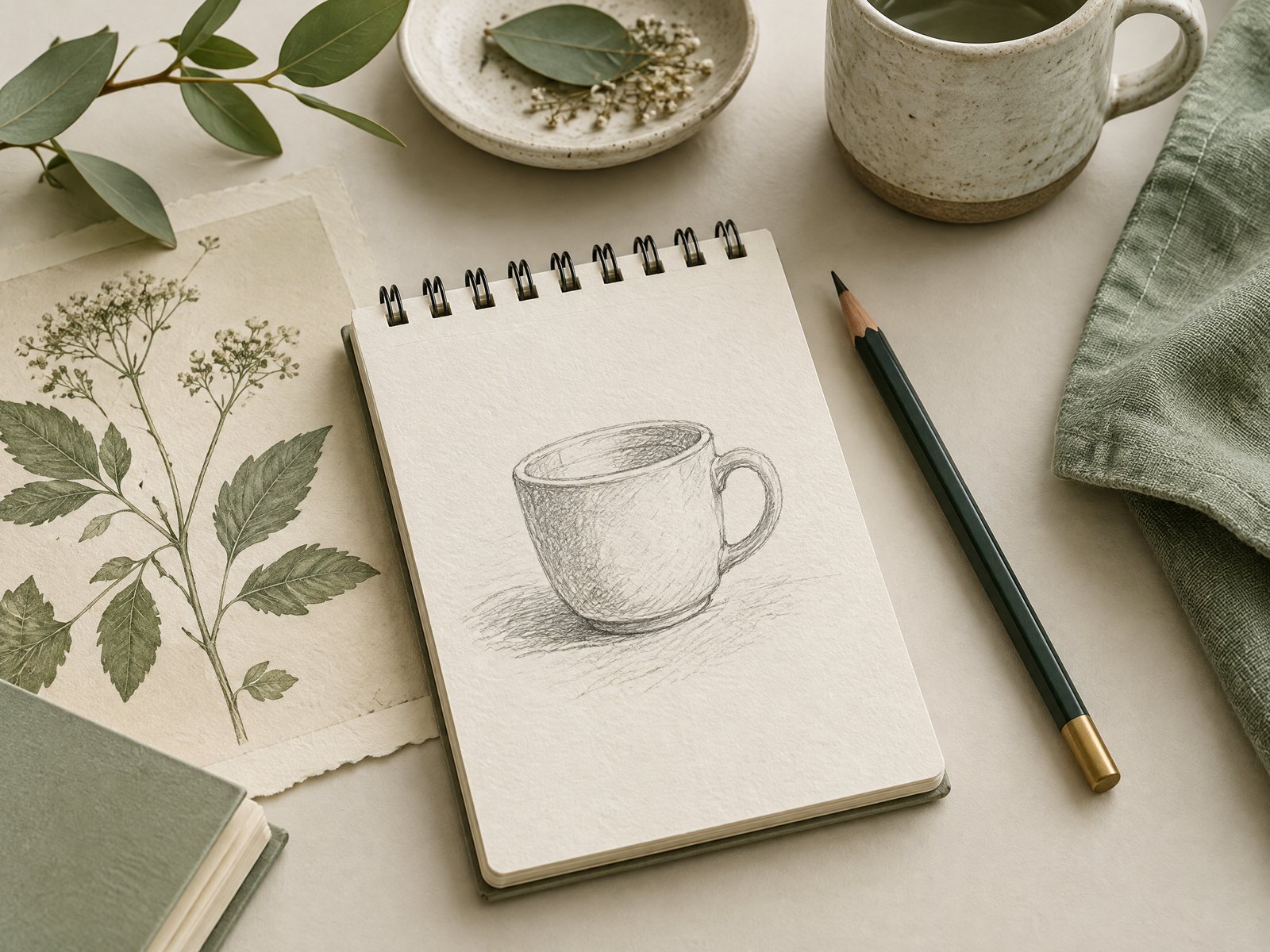
A useful observation begins with choosing what to leave out. For a cup, decide whether the handle belongs in the first outline or whether it is a second shape to add after the bowl. For a plant, choose one leaf rather than trying to record the whole plant. For a street view, crop the scene to a doorway, a parked bicycle, or the meeting point between pavement and wall.
Try this four-pass sequence:
1. Locate. Make two or three light marks to indicate the top, bottom, left, and right edges of the subject. They are guides, not a finished frame. 2. Trace relationships. Compare one distance with another. Is the handle half as wide as the cup? Does the shadow extend farther than the object is tall? Use relative questions instead of chasing measurements. 3. Choose emphasis. Darken only the area that helps the viewer understand the form: the inside of a bowl, the overlap of two leaves, or the gap under a chair. 4. Annotate the change. Add a small note such as “sun moved behind cloud” or “steam disappeared.” This makes the page about a moment, not only an object.
These choices also work when the subject is visually unremarkable. A pile of mail can provide overlapping rectangles; a spoon can provide a long axis and a reflective curve; a curtain can provide a repeated vertical rhythm. Look for relationships—edge, gap, repetition, shadow—rather than waiting for a picturesque view.
When the scene is crowded, select a quiet anchor. If a café table contains cups, wrappers, hands, and menus, draw the nearest cup and indicate the rest with two or three suggestive lines. If a garden view is too complex, choose the boundary between one leaf and the soil. The adjustment is not a failure to capture everything; it is a decision about what deserves attention today.
Adjust the kit when the habit meets real life
When you only have three minutes: use a “shape receipt.” Draw the outside contour of one nearby item, add the date, and write one sensory-neutral visual fact: “rim is darker on the left.” Avoid trying to shade. The small result keeps the chain of practice intact without pretending that every day offers the same time.
When the page looks stiff: switch from object naming to movement. Instead of “draw the chair,” write “follow the four legs from floor to seat.” Let your pencil travel continuously for a short interval, lifting only when necessary. This can loosen the habit, but it does not need to become a style or a claim about artistic improvement.
When you keep erasing: set a no-correction pass. Make the first outline in a lighter touch, then add one darker pass without removing the earlier marks. The page will show decisions and changes. If that feels too exposed, reserve the back of a page for warm-ups and keep the front for observations you want to revisit.
When the kit becomes cluttered: remove one tool after each session and ask what you missed. If the answer is “nothing,” leave it out for a week. A notebook, pencil, and prompt may be enough. If you repeatedly need a sharpener, give it a permanent place; if you never use a decorative item, let it be an optional accent rather than part of the daily kit.
When you travel or observe in public: keep the setup discreet and choose subjects without recording private information. A building edge, your own drink, or a public tree is sufficient. Do not sketch identifiable personal documents, screens, or people who have not agreed to be included. Observation can be attentive without becoming intrusive.
Turn pages into a gentle record
At the end of each week, place three pages side by side. Look for concrete differences: larger marks, fewer objects, a repeated viewpoint, or notes about changing light. Do not score the drawings. Instead, choose one question for the next week: “Can I leave more blank space?” “Can I draw the shadow before the object?” or “Can I revisit one subject at a different time?” A question gives the next session direction without turning it into a test.
You can also make a tiny index on a separate page: date, subject, and location in three short lines. This is different from organizing notebook sections; it is simply a way to find a moment again. If you want a visual marker, use a removable note or a plain tab rather than covering the drawing with decoration. The record should help you return to looking.
A Farouk selection can supply the practical pieces for this small ritual, but no catalog item has to define the result. Match the surface to your comfort, the case to your carrying pattern, and the prompt to the kind of attention you want to give. Then place the kit where an ordinary scene can interrupt you—in a kitchen drawer, beside a reading chair, or in the bag you actually use.
The finished goal is modest: a page that says where you were, what caught your eye, and what changed while you stayed with it. Once that page is possible, the next one does not need to be impressive. It only needs to offer another reason to look.
If you need help selecting a format or checking a current item, contact Farouk Book Store.
Related reading: Continue with How to Start a Reading Journal You Will Actually Use, Creative Notebook Sections for One Useful Everyday Book, and Notebook Size Guide for Journaling, Lists, and Travel.