Finding small gifts for book club members is less about buying a dozen identical objects and more about noticing how different people read. One member may annotate every page, another may switch between paperbacks and an e-reader, while someone else mainly enjoys the conversation and the ritual of meeting. A thoughtful gift can acknowledge the shared love of books while still giving each person a choice that feels personal.
The easiest approach is to set a common limit, choose one useful gift category, and vary the design or function within it. Bookmarks are especially practical because they are compact, easy to present, and connected to reading without assuming a particular genre. The bookmarks collection offers a focused starting point; from there, you can match each item to a member’s habits, personality, or favorite meeting mood.
Start with a shared gift rule, not a matching gift
Before browsing designs, decide what should be consistent. A shared rule keeps the exchange fair while leaving room for individuality. For example, everyone might receive one bookmark, each person might get one small stationery item, or every gift might stay below the same spending ceiling. Consistency in value or purpose matters more than identical packaging.
A useful three-question check is:
- Will this person use it? A reader who travels may prefer something slim that can move between books. A member who keeps a reading journal may enjoy a design that doubles as a visual accent.
- Does it suit the group without defining the person too narrowly? A whimsical design can be fun, but avoid assuming that every reader wants a literary quote, a romance motif, or a particular color.
- Can you explain the choice in one sentence? If the reason is clear—“This reminded me of your love of rainy-day reading”—the gift feels intentional rather than randomly assigned.
You can also create a simple allocation system. Write each member’s name on a list and note one observable preference: carries a paperback, uses a planner, likes bright colors, or keeps notes during discussion. Then assign gifts from different visual families. This prevents the common mistake of buying the first design you like five times and discovering that it does not suit half the group.
If tastes are hard to read, use a low-risk structure: give everyone the same type of item but different designs. The gift remains equal, while the variation makes the handoff more personal. When the group has a wide age range or mixed reading styles, ask the organizer to collect preferences privately, such as “bright, neutral, cute, or simple.” That small step can prevent awkward guesses.
Use bookmark designs to reflect reading personalities
A bookmark is a strong default because it solves a real reading problem: keeping a place without folding a page. Look for a slim profile and an easy-to-handle shape, then vary the artwork rather than treating one design as universally appealing. The Farouk Stacked Books Cute Aesthetic Bookmark is a direct choice for the member who enjoys an unmistakably bookish look. It is approximately 2 x 6 inches, printed on both sides, and has rounded corners.
For a member whose reading ritual is quiet and atmospheric, the Rain Day Cute Aesthetic Bookmark offers a rain-themed alternative. Its slim format, double-sided artwork, glossy cardstock, and rounded corners make it suitable for novels, journals, or planners. If the recipient prefers dreamy visuals, the Starry Clouds Cute Aesthetic Bookmark is another option, with a star-and-cloud design and a similar compact format.
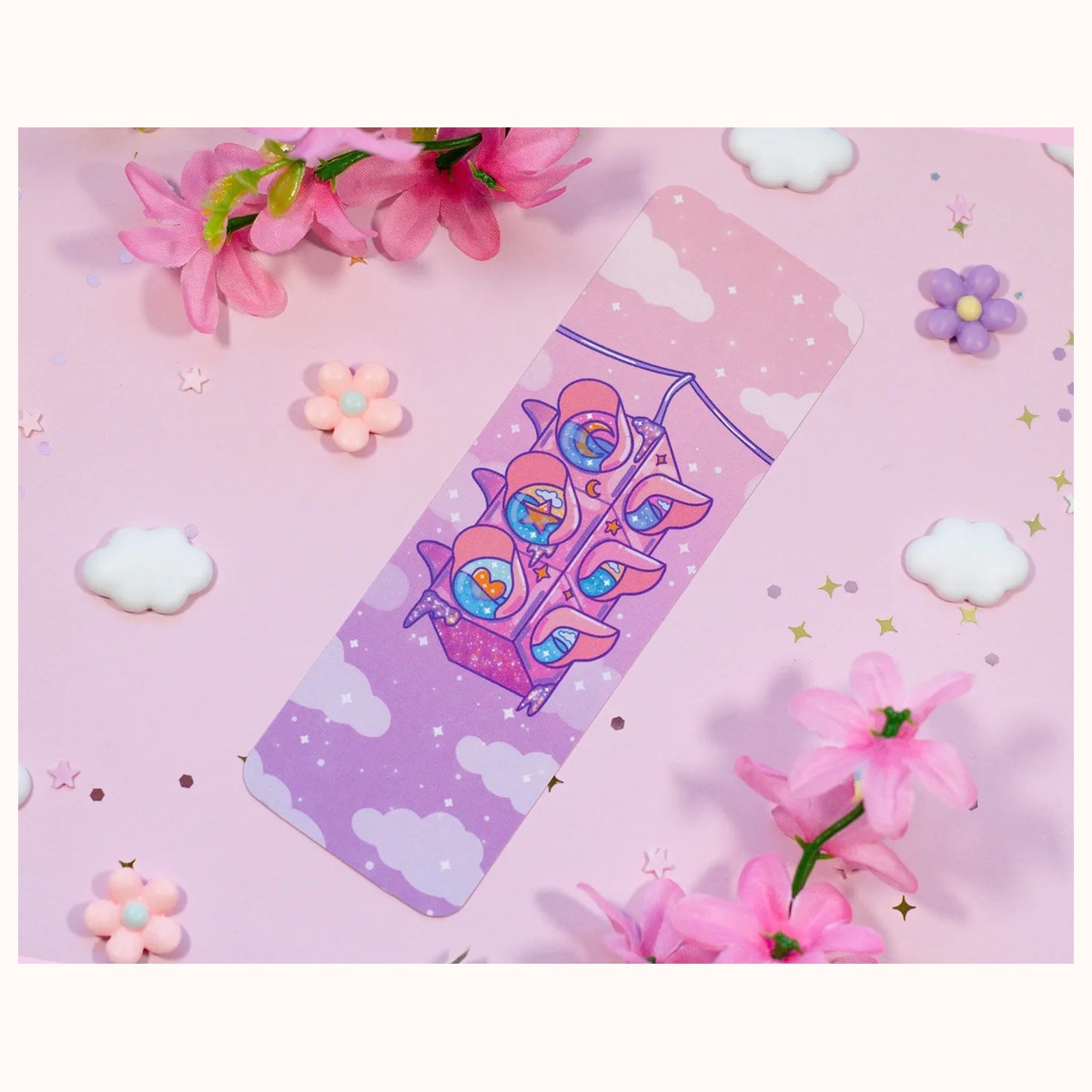
Other members may respond better to a more specific visual cue. The Sunset Music Player Cute Aesthetic Bookmark can suit someone who pairs reading with playlists or enjoys nostalgic graphic details. A member with a playful, design-led style might like the Traffic Light Cute Aesthetic Bookmark. These are not personality tests; they are conversation starters. Choose based on what you have genuinely noticed, not on a stereotype.
There is also a practical decision between one design family and several. If the club has a strong shared identity, such as a monthly theme or a regular meeting location, several related designs can look cohesive in a group photo. If members barely know one another, use clearly different motifs so nobody has to remember whose identical item is whose. If a bookmark may be used in a very delicate book, remind recipients to store it flat and avoid forcing it into a tightly packed volume.
Build a tiny add-on only when it improves the gift
A single bookmark is enough when the club wants a simple gesture. Add-ons can be helpful, but they should support the reading habit rather than turn a small gift into clutter. A short handwritten note is often the best addition: write the title of the next discussion book, a one-line thank-you, or the reason you selected that design. Keep the message specific and avoid spoilers.
For members who take notes, a compact writing item can make sense. A sticky note pad can hold a question while someone reads, mark a passage temporarily, or capture a thought before the meeting. The Writer Aesthetic Cute Sticky Note Memo Pad is a 3 x 3 inch pad with 50 adhesive sheets, so it is more functional than a decorative extra. Use it for the note-taking member rather than automatically adding one to every package.
A small themed pairing can work when it stays within the same purpose. For example, give a bookmark plus a brief discussion prompt card: “Which character changed most?” or “What image stayed with you?” This makes the gift part of the next meeting without requiring expensive materials. Alternatively, pair a bookmark with a short note inviting the recipient to choose the next book, lead a question, or bring a favorite quotation.
Avoid add-ons that create hidden complications. Food can conflict with allergies or preferences; scented items may be unwelcome; and anything bulky can be inconvenient for members who commute. If the group exchanges gifts at a café or library, compact packaging is kinder than elaborate boxes. When in doubt, stop at the bookmark and make the message the personal element.
Plan the handoff, wrapping, and last-minute fixes
Presentation does not need to be elaborate. Put each bookmark in a small paper sleeve or envelope, write the recipient’s name clearly, and include a one-sentence explanation. To keep designs from being revealed too early, use opaque envelopes and place all gifts in a basket for distribution. If the group prefers an open selection, lay out the gifts with names attached so the choice remains intentional rather than competitive.
For a club with a tight budget, buy by category and vary only the design. For a larger club, set aside a few spare options in case a guest arrives, a member’s preference changes, or an item is damaged before the meeting. Keep a record of who received which design; that prevents accidental duplication at the next gathering. It is also useful when someone misses a meeting and needs their gift held back.
Check the catalog listing before ordering or presenting any item. Colors can appear different in photographs, and handmade elements may have minor variations. Descriptions for the bookmarks identify approximate dimensions and finishes, so use those details as guidance rather than promising an exact appearance. If you need to confirm current availability, product details, or an order question, use Farouk Book Store’s contact page rather than guessing.
If a recipient says the design is not their style, keep the exchange comfortable: offer a private swap, let them pass it to another reader, or suggest using it in a journal. The goal is not to prove that every choice was perfect. It is to recognize the group’s shared reading time while respecting individual taste. A small gift succeeds when it is useful, easy to carry, and accompanied by a thought that could not have been written for just anyone.
Related reading: How to Build a Personalized Gift Bundle · Why Small Gifts Create Big Connections · Why Handwritten Greeting Cards Still Matter