A reading log does not need to be a large notebook or a complicated spreadsheet. With reading log bookmarks, you can keep a small record inside the book you are already carrying. A few lines can tell you where you stopped, what you thought, and what you want to remember later. The method works for novels, textbooks, essays, and books you read in short sessions.
This guide explains how to choose a bookmark format, decide what to write, build a repeatable routine, and fix common problems such as running out of space or losing track of several books. The goal is not to document every sentence. It is to make returning to a book easier and your reading history more useful.
Choose a Bookmark Format That Matches Your Reading Habit
Start with the way you actually read, not the system you imagine using. If you read one novel at a time and mainly need to remember your page, a slim bookmark with a small notes area may be enough. If you alternate between fiction, nonfiction, and study material, use separate bookmarks or a bookmark plus a nearby note card so each title has room for its own details.
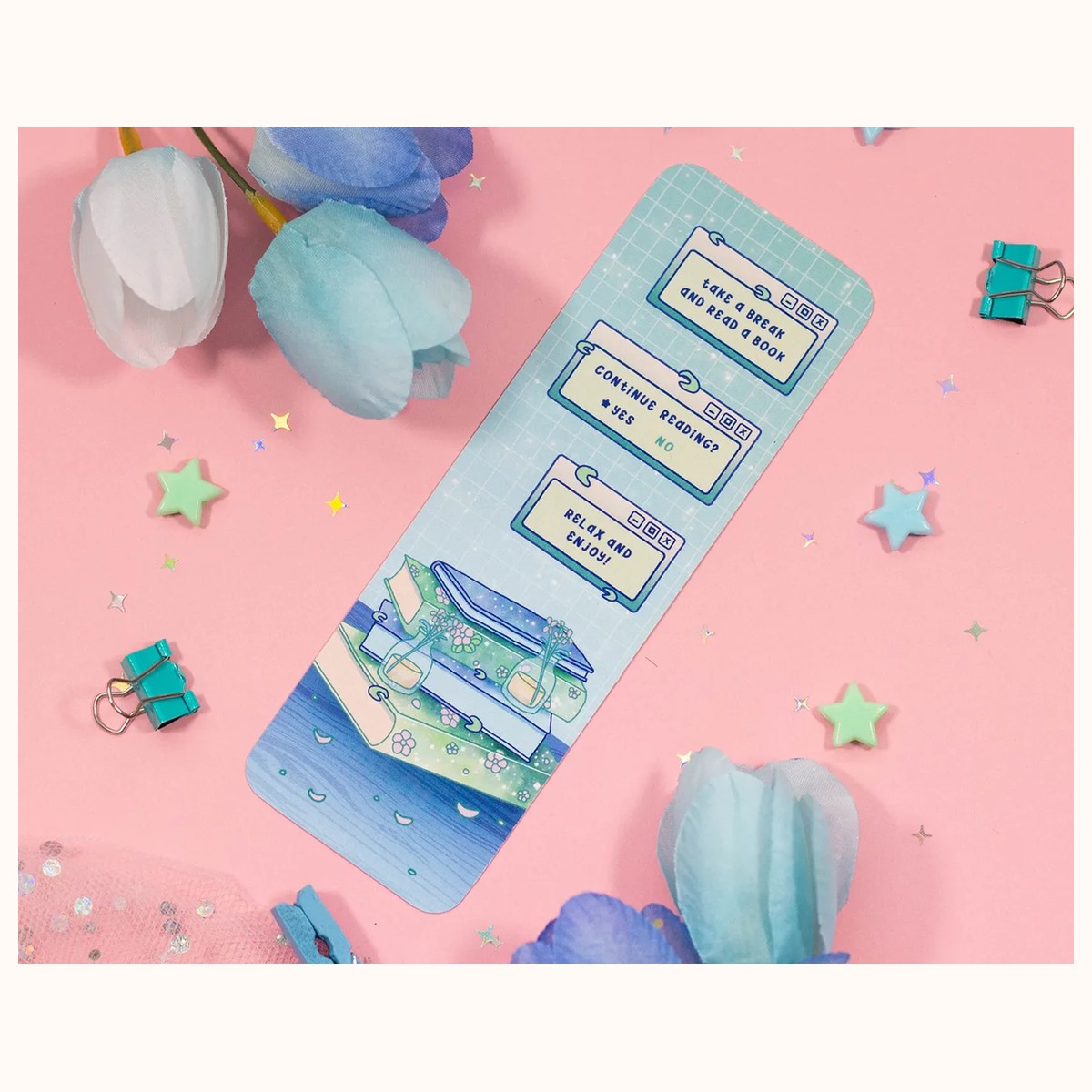
A physical bookmark should stay flat and be easy to move. For example, the [Stacked Books Cute Aesthetic Bookmark](/products/stacked-books-cute-aesthetic-bookmark) is listed at approximately 2 by 6 inches, with rounded corners and double-sided printing. Its slim profile makes it a sensible page marker for a paperback while you keep the actual log on the reverse side with a pencil or in a companion note. A bookmark is not a good place for bulky attachments: avoid adding clips, thick charms, or several layers of paper that could press against the spine.
You can also choose a bookmark by the kind of tracking you want:
- Location tracking: Write the date, page number, and chapter whenever you stop.
- Reflection tracking: Add one sentence about a character, argument, image, or question.
- Progress tracking: Record pages read or a percentage after each session.
- Reading-list tracking: Use a second bookmark to hold titles you want to start next.
For a more visual option, the bookmarks collection brings the formats together in one place. The Starry Clouds Cute Aesthetic Bookmark is another real example from the catalog; it is described as a 2 by 6 inch, double-sided bookmark with rounded corners. Pick the design you will recognize quickly when several books are open around your home.
Before committing to a format, test it in your largest current book. Slide it between pages, close the cover, and check whether it stays flat. If it bends, slips out, or makes the book difficult to close, use it only as a desk-side log and choose a thinner marker for the book itself.
Set Up a Simple Reading Log System
The most reliable log has a fixed structure. A repeatable structure prevents the common problem of writing a detailed entry one day and abandoning the system the next. Reserve four short fields:
1. Book: title, author, or a brief abbreviation. 2. Session: date and the page or chapter where you stopped. 3. Note: one observation, question, or useful takeaway. 4. Next step: continue, look something up, discuss it, or return the book.
If your bookmark has no printed lines, write this template on the back of a small card:
`Book — date — page/chapter — one thought — next step`
A pencil is practical for a reusable bookmark because you can update the latest line, but a fine-tip pen can work when the bookmark is intended as a permanent record. Test any writing tool on an inconspicuous area first. If ink smears or shows through, write on a separate card rather than turning the bookmark into a messy log.
Keep each entry short enough to complete in under a minute. For a novel, an entry might read: “13 Oct — p. 84, chapter 6 — the narrator is hiding the letter — continue tomorrow.” For a nonfiction book: “13 Oct — pp. 42–55 — compare this idea with the earlier definition — flag for review.” For a textbook: “13 Oct — section 3.2 — understand the example, revisit the diagram.” These notes are specific enough to restart your thinking without becoming a second set of full notes.
Decide how you will handle finished books. One option is to add a closing line: “Finished — 13 Oct — 4/5 — memorable setting, slow middle.” Another is to move completed entries to a notebook or digital list while leaving only the current book’s information on the bookmark. Choose the approach you will actually maintain. A short paper trail is more useful than a perfect system that takes longer to update than to read.
Use the Bookmark During Every Reading Session
Begin by placing the bookmark at your stopping point before you close the book. Then write the page and chapter while the information is still clear. This small order matters: if you write first and move the marker later, the physical location and the written location can disagree.
During the session, mark only information that will help a future version of you. Try one of these prompts:
- What changed since the last session?
- Which idea or scene deserves a second look?
- What prediction, question, or connection did I make?
- Did I stop because the book was complete, or because I lost momentum?
- What is the smallest useful next action?
A “next action” prevents a vague log. Instead of “interesting chapter,” write “read the footnote on page 119” or “notice whether the symbol returns.” If you are reading for pleasure, it can be as simple as “start chapter 8 with coffee.” If you are studying, write the task that makes review easier: “make three flashcards from this section.”
Use a consistent notation to scan old entries. For example, put a star beside a passage to revisit, a question mark beside an unresolved point, and a check mark beside a completed follow-up. Keep the symbols few. Five symbols may feel organized at first but become slow to remember. Two or three are enough for most readers.
For books shared with other people, keep personal reactions separate from borrowed notes. Write your own response on the bookmark and use a removable sticky note for a question to discuss. This avoids confusing your reading history with somebody else’s comment and lets you remove the discussion note without disturbing the book.
Review, Troubleshoot, and Improve the System
Review your bookmark when you finish a chapter, complete a book, or begin a new week of reading. A review can take two minutes. Look for unfinished next steps, repeated themes, and books that have stalled. If a title has not moved for several sessions, choose deliberately: continue for one more chapter, change the format, or place it on a paused list. A reading log should support decisions, not make every book feel like an obligation.
Here are common problems and practical fixes:
- The bookmark has no room left. Keep only the latest location on the bookmark and move older entries to a notebook. Add the book’s title to every transferred page so it remains identifiable.
- You are tracking multiple books with one bookmark. Use a title abbreviation and a different line for each session, or assign one bookmark per active book. Do not rely on memory to match an unlabeled page marker to a title.
- You forget to write entries. Attach the habit to closing the book: page first, note second, bookmark third. If that still fails, record only date and page for a week before adding reflections.
- The page number is not enough. Add chapter, section, or a distinctive scene. This is especially helpful in ebooks, editions with different pagination, and books with introductions numbered separately.
- The bookmark slips out. Use a slimmer marker, place it a little deeper in the text, and avoid carrying the book loosely with the pages open. If the problem continues, keep a backup page marker in the book’s inside cover.
- Your notes become too long. Set a one-sentence limit. Capture the prompt for future thought, not a complete review. You can expand the idea later in a journal.
When you finish a book, transfer three details to your long-term list: completion date, a brief rating or mood, and one reason you would or would not recommend it. Then clear the reusable bookmark or start a fresh page. If you prefer keeping physical memories, leave the final entry intact and store the bookmark with the book; this works well for favorites you expect to revisit.
Finally, check the catalog details before choosing a bookmark for a particular purpose. The Farouk Book Store bookmarks collection is the right starting point for current bookmark options, while the Stacked Books Cute Aesthetic Bookmark product page gives the specific design details for that example. For questions about an item or its availability, use the store’s contact page rather than guessing from an old note or image.
A good reading log bookmark does one job well: it reconnects you with your book. Keep the record brief, make the next step clear, and adjust the system whenever it creates more friction than insight.
Related reading: How to Build a Personalized Gift Bundle · How to Choose Stickers for Journals and Planners · Best Stickers for Scrapbooking: A Creative Guide