A handwritten note can be easy to misplace and surprisingly difficult to replace. The problem is not always a lack of storage; it is that a drawer full of old paper gives no clue which pieces still matter, who agreed to have them kept, or when it is appropriate to read them again. Farouk Book Store’s paper selection can support a smaller, more deliberate approach: a personal collection built around meaning, consent, and a calm habit of revisiting.
This is not a system for preserving every receipt, greeting, or scrap. It is a way to make a modest place for notes that carry a memory, a turning point, a particular voice, or a reminder you intentionally want to keep. The collection can be physical and simple, while the decisions behind it remain thoughtful.
Decide what earns a place
Begin with a definition that is narrow enough to use. A meaningful note might be a short message from someone you love, a thank-you you want to remember, a card from a difficult transition, or a few lines you wrote to your future self. It does not need to be eloquent. A smudged sentence may matter more than a polished card if it preserves a moment you would otherwise lose.
Use three questions for each candidate:
1. What does this paper help me remember? Name the event, relationship, decision, or feeling in plain language. 2. Would I still choose to keep it six months from now? This pauses the impulse to preserve everything just because it arrived today. 3. Is keeping it respectful? Consider whether the writer would reasonably expect the note to remain private and whether it includes someone else’s personal information.
A “yes” to the first question is not an automatic yes to the collection. If a note contains a phone number, a home address, a health detail, or a story that belongs partly to another person, you can keep the memory without keeping every detail. Ask the writer before retaining or sharing it when the relationship and circumstances make that appropriate. Consent is especially important if you intend to scan, photograph, quote, post, or show the note to anyone else.
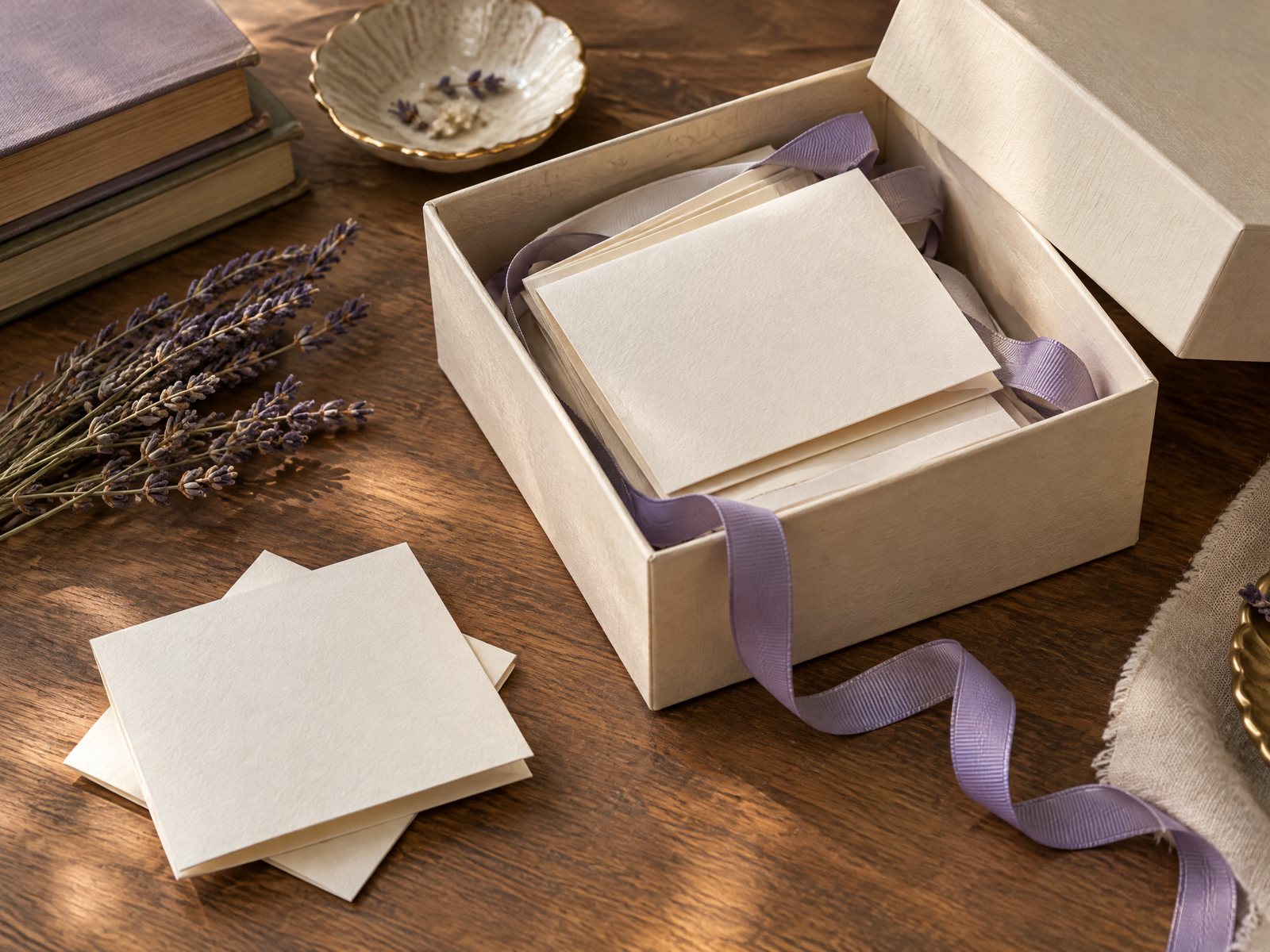
Set a size boundary before you start. One small box, one envelope portfolio, or one defined section of a notebook is enough. A finite container turns selection into an intentional act. When it fills, you can review the contents instead of adding another unexamined pile.
For a fresh piece of paper used to invite a message, consider the Note Cards collection. The purpose is not to make a note look important; it is to give a future message a clear place to begin.
Build a simple, private structure
A useful collection needs just enough structure to make retrieval comfortable. Divide it into three groups: keep now, review later, and release. “Review later” is not a disguised trash pile. It is for notes whose meaning is unclear while emotions are fresh, or for duplicates where you want time before choosing.
A small card or slip at the front can record only neutral information: the date received, the occasion, and the writer’s first name or relationship if you are comfortable using it. Avoid creating a detailed index that repeats sensitive content. A line such as “spring move,” “after the performance,” or “ordinary Tuesday” may be enough to find the memory without turning private words into a catalog.
Choose a container that closes and can be put away. A lidded box, a dedicated drawer, or an envelope inside a personal file is more suitable than a display area if the notes are private. Keep the collection separate from active paperwork so a note does not get mistaken for an appointment, bill, or current task. If several people share your home, decide where it can be stored without requiring anyone else to guess what is confidential.
You can use a new envelope as a boundary for a small subset, such as notes from one year or one life chapter. The Botanical Bliss Envelopes are A7 envelopes, approximately 5.25 x 7.25 inches, and come as a set of 10. Their printed design makes a clearly labeled chapter feel distinct, while the set leaves room for several separate groupings. Confirm the fit before inserting anything larger than a standard note, and avoid forcing folded paper into a tight enclosure.
For a neutral option, label the outside with a private shorthand rather than a revealing phrase. “2019–20” may be more considerate than “hard year.” If the collection includes notes from another person, do not assume that a decorative label gives you permission to display it. The outside should protect context, not announce it.
Select notes with care, not nostalgia alone
Keep an original when its handwriting, paper, or physical marks are part of the memory. A note with a coffee ring from a particular morning may be worth preserving as an object. Keep a transcription or brief summary instead when the content matters but the original contains information you should not retain. If you summarize, mark the summary as your own words rather than presenting it as a quotation.
Consider four useful categories:
- Milestones: a move, graduation, new job, reunion, or other specific change.
- Everyday kindness: an unexpected check-in, a funny observation, or a message that arrived at the right time.
- Your own notes: reminders of a decision, a promise to yourself, or an observation you want to revisit.
- Open questions: paper that still matters but needs a later decision about privacy, ownership, or whether the relationship has changed.
Do not keep a note solely because you feel guilty discarding it. Gratitude and storage are different things. You can thank someone, remember the occasion, and release the paper. Likewise, do not keep a painful note as proof that an experience happened if rereading it repeatedly is not something you want. A collection should serve your chosen memory practice, not impose a duty to revisit distressing material.
If a note belongs to someone else, return it when it was lent to you or when the context suggests it was not meant to be permanent. If returning the original is not possible, ask whether a scan or transcription is welcome before making one. Keep copies as private as originals, and delete them when the person withdraws permission or circumstances change.
Create a low-pressure revisiting ritual
Revisiting does not need to be a monthly performance or a test of how much you remember. Pick a repeatable cue: the first weekend of a season, the end of a project, or an ordinary quiet afternoon every few months. Set a short limit, perhaps fifteen minutes, and choose no more than three notes. The constraint keeps the ritual from becoming a complete reorganization project.
For each note, write one new line on a separate review sheet:
- What do I understand differently now?
- What detail had I forgotten?
- Do I still want the original kept in this collection?
The point is not to score the note or judge the writer. It is to notice change. A message that once felt urgent may now be a gentle historical marker. A casual sentence may reveal why a day stayed with you. If a note no longer belongs, move it to a release envelope and decide later whether to recycle, return, or securely destroy it. Do not photograph it “just in case” unless you have a clear reason and the right to keep a copy.
A compact writing surface can make the ritual easier without expanding the archive. For example, Reading Room Note Cards come as 50 cards measuring 3 x 5 inches, with one ruled side and one blank side. One side can hold your current reflection; the blank side can hold a simple date or category mark. Because the card is separate from the original, you can update your perspective without writing on a keepsake.
If your notes are mostly brief reminders rather than folded messages, do not force them into this collection. Keep active reminders in your normal planning system, then remove them when their task is done. A meaningful-note box is not a backup calendar, a diary of every conversation, or a place to store unresolved administration.
Adjust when the collection stops feeling meaningful
Watch for predictable failure cases. If you keep choosing notes because they are attractive, add a rule that meaning must be described in one sentence. If the box is too full, pause new additions for a month and review duplicates. If privacy feels uncertain, move the collection to a closed location and ask permission before showing any part of it. If rereading leaves you tense or stuck, shorten the session, skip that item, or choose not to revisit it. This is a personal paper practice, and you do not owe the collection unlimited attention.
When choosing items from Farouk Book Store, treat the catalog as an editorial selection of paper goods from different designs, not as a claim that Farouk manufactured every design. Product details can help you choose a size or format, but availability and order details should be confirmed: the website bag prepares an email order request rather than functioning as a payment checkout, and inventory, taxes, and shipping require confirmation. You can contact Farouk Book Store if you need to clarify a product before planning your collection. For general context about the shop and its selection, visit the About page.
The finished collection may contain only five notes. That is enough if each one has a reason to be there, a respectful place to rest, and a future moment when you can choose whether to read it. Meaning grows through attention and boundaries, not through volume. A small box that you can revisit on purpose will serve you better than a crowded archive you avoid opening.
Related reading: Why Handwritten Greeting Cards Still Matter, How to Build a Personalized Gift Bundle, and Why Small Gifts Create Big Connections